Author

admin

Browsing

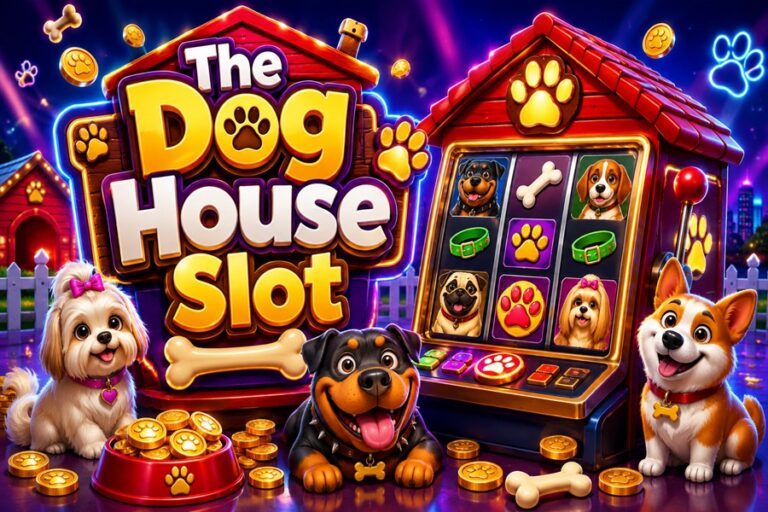
The Dog House slot is one of the most-played titles Pragmatic Play has ever released. It looks like a children’s cartoon. Under the hood, it is a high-volatility game built around one clever idea: sticky wild multipliers.

Most guides tell you the theme is cute and the bonus is good. This one goes further. You will learn exactly how the multiplier math works, why the RTP you see may not be the RTP you get, how the free spins count is decided, and how every version in the Dog House family stacks up.

If you only remember one thing: nearly all of the game’s win potential lives in the free spins round. The base game is the waiting room.

18+ / 21+ only. Slots are games of chance. Outcomes come from a certified random number generator. No strategy changes the odds, and past spins never predict future ones. Play for entertainment, and only with money you can afford to lose.

The Dog House slot at a glance

Feature Detail
Provider Pragmatic Play
Reels and rows 5 reels, 3 rows (5×3)
Paylines 20 fixed
Default RTP 96.51%
Volatility High
Max win 6,750x your bet
Min bet 0.20
Max bet 100 (up to 150 at some operators)
Key feature Sticky wild multipliers in free spins
Wild multipliers 2x or 3x, added together
Free spins Random 9 to 27
Retrigger No
Format HTML5, mobile and desktop
Demo mode Yes

What is The Dog House slot and who made it?

The Dog House is a video slot from Pragmatic Play, a studio founded in 2015 and based in Gibraltar. In under a decade it became one of the most widely distributed slot makers in the world, and this title is one of its flagship games.

The setting is a sunny suburban backyard. Green lawns, a white picket fence, a wooden kennel, and a cast of cartoon dogs. The tone is cheerful and light.

That cheerful tone hides a serious risk profile. This is a high-volatility slot, which means the on-screen mood and the actual gameplay pull in different directions.

How does The Dog House slot actually work?

The game runs on a classic 5×3 grid with 20 fixed paylines. Every line is always active. Wins pay from left to right, and only the highest win on each line counts.

There is no cascade, no tumble, and no cluster pays. Symbols spin and stop. This simplicity is deliberate, and it is why the game reads so cleanly on stream and on mobile.

Symbols split into three tiers.

Tier Symbols Rough top payout (5 of a kind)
Low 10, J, Q, K, A royals up to 2.5x
Mid Bone, dog lead around 0.4x and up
High Four themed dogs (hound, pug, chihuahua, doberman) up to 37.5x
Wild The dog house (kennel) substitutes, carries a multiplier
Scatter Paw print triggers free spins

The top dog symbol is the biggest base-game payer. On its own, though, no regular symbol gets you near the max win. That job belongs entirely to the wilds.

How do the sticky wild multipliers work in The Dog House?

This is the mechanic that defines the game, and it is where most casual guides get the details wrong.

Here are the rules that matter:

  • The wild is the dog house symbol.
  • Wilds appear only on reels 2, 3, and 4.
  • Every wild carries a random 2x or 3x multiplier.
  • A wild multiplier applies to any winning line it helps complete.

Now the part people misread. When two or more wilds land on the same winning payline, their multipliers are added together, not multiplied. Two 3x wilds do not make 9x by multiplication. They make 6x by addition. Three 3x wilds across all three wild reels give the theoretical ceiling of 9x on a single line.

That distinction changes how you read the game. The math is generous but capped, and it rewards clustered wilds on the middle reels rather than lucky single hits.

How do you trigger free spins in The Dog House slot?

The scatter is the paw print. It lands only on reels 1, 3, and 5. Because it needs those three specific reels, the trigger is genuinely tough, which is part of the high-volatility feel.

Land three scatters and a bonus animation plays. A 3×3 grid spins and reveals numbers that are added up to set your free spin count. That count is random and typically lands anywhere from 9 to 27 free spins. Many articles simplify this to a flat “10 spins,” but the grid-based range is the accurate mechanic.

Inside the round, the game transforms:

  1. Every wild that lands becomes sticky. It locks in place for the rest of the feature.
  2. Each sticky wild keeps its 2x or 3x multiplier active on every remaining spin.
  3. As wilds pile up across the grid, multipliers stack line by line.
  4. A grid loaded with sticky 3x wilds is how the game climbs toward its ceiling.

One important limit: the original Dog House does not retrigger. Scatters do not appear during the feature, so you cannot extend the round. What you win, you win inside your first allotment of spins.

What is the RTP of The Dog House slot, and why does it vary?

The default Return to Player is 96.51%, which sits slightly above the industry average. Over thousands of spins, the game is designed to return that share of total wagers.

Here is the detail almost no one flags clearly. Pragmatic Play supplies operators with multiple RTP configurations, and some casinos deploy lower versions. Across the wider Dog House family, floors as low as 94.47% have appeared on live sites.

That is a meaningful gap. A drop from 96.51% to 94.5% roughly doubles the built-in house edge. And the RTP is rarely advertised on the lobby thumbnail.

Practical takeaway: before you spin, open the game’s information or paytable screen and read the stated RTP. If it shows a reduced figure, a different casino may run the full-value version of the exact same game.

How volatile is The Dog House slot?

Very. It is a high-volatility title, rated at or near the top of Pragmatic Play’s own risk scale.

In plain terms, that means long stretches where little happens, punctuated by rare bigger hits. The base game can feel, as one reviewer put it, like a long hallway with one bright door at the end.

That door is the free spins round. Because the wilds only appear on three reels and the scatters only on three others, the game holds back its energy until the bonus arrives.

For your bankroll, high volatility means sharp swings. Large bets are risky here, because dry spells can drain a balance fast before a bonus ever lands.

What is the maximum win in The Dog House slot?

The maximum win is 6,750x your bet.

You reach it the same way every big win here happens: by stacking multiple sticky wilds carrying 2x and 3x multipliers across paylines during free spins, ideally with the high dog symbols filling the grid at the same time.

It is a strong ceiling for a game this simple, though newer relatives in the series push much higher. More on that below.

Can you buy the bonus in The Dog House slot?

At many operators, yes. A bonus buy (also called Feature Buy) lets you pay a set multiple of your stake to jump straight into free spins instead of waiting for three scatters.

Two things are worth understanding before you use it.

First, buying the feature does not change the game’s long-term math. A bonus-buy price is calibrated so the RTP stays roughly the same as spinning organically. You are paying for speed and certainty of entry, not for better odds.

Second, availability varies. Some regulated markets ban bonus buys entirely, so the button may be missing depending on where you play.

How do the Dog House series versions compare?

This is where the Dog House name really lives now. It is no longer one game. It is a franchise, and the versions differ far more than the shared art suggests.

Version Theme Grid or ways Volatility Default RTP Max win
The Dog House (original) Suburban backyard 5×3, 20 lines High 96.51% 6,750x
The Dog House Megaways Same, expanded Up to 117,649 ways High (max) 96.55% 12,305x
The Dog House Multihold Kennel grid Four-section multi-grid High ~96.5% high
The Dog House Muttley Crew Pirates 5×5 cluster pays High as low as 94.47% high
The Dog House Dog or Alive / No Dog Left Behind Wild West 5×3, enhanced RTP High up to 98.02% 10,000x
The Dog House Royal Hunt Victorian aristocrats 5×3, 20 lines High 96.53% 8,000x
The Big Dog House Suburban, modern 5×3, 20 lines Medium 96.53% 15,000x

A few things stand out that the marketing does not spell out:

  • The original is the cleanest. It remains the reference point for the series because its single mechanic is so readable.
  • Megaways is the most volatile. It adds a second free spins mode (Sticky or Raining Wilds) and a far higher ceiling, but it also produces longer barren runs.
  • Royal Hunt adds premium multipliers behind a paywall. Its standard buy costs 100x, while a Royal buy costs 500x and swaps the usual 2x/3x wilds for 10x or 20x. That 500x price is steep for a max win only modestly above the original.
  • The Big Dog House shifts to medium volatility yet carries the highest ceiling in the family at 15,000x. It targets players who want variety without surviving a maximum-variance grind.
  • Enhanced RTP editions exist. Some later entries advertise RTPs near 98%, which are among the highest you will find on a game this playful.

What do real players say about The Dog House slot?

Player sentiment, drawn from slot forums, streamer communities, and review threads, is consistent and useful.

What players like:

  • The feature structure is clean and easy to follow, which made the original a streamer favorite. Reliable, readable bonus triggers translate well on camera.
  • When the bonus behaves, a quiet session can turn around fast as wilds stack.
  • The art and barking sound effects are genuinely charming on first play.

What players criticize:

  • The base game is repetitive. Forum reviewers describe long dry spells with “almost nothing outside the bonus rounds.”
  • The soundtrack fades into background noise after enough spins. Competent, not memorable.
  • Spin-off variants get mixed reactions. The Muttley Crew cluster edition, in particular, drew forum criticism for static gameplay and a below-average RTP configuration on some sites.

The common thread across communities: this is a bonus-chasing game. Enjoyment rises or falls entirely on how the free spins land, so patience and bankroll discipline matter more than they do on a steady, low-volatility slot.

How does The Dog House compare to Sweet Bonanza and Gates of Olympus?

All three are Pragmatic Play headliners, but they play very differently.

  • Gates of Olympus and Sweet Bonanza use tumble mechanics. Winning symbols vanish, new ones drop, and multipliers build across chained wins. Excitement is spread across the whole session.
  • The Dog House uses a traditional spin-and-stop grid. Excitement is concentrated in one place: the free spins round.

On ceilings, Sweet Bonanza reaches roughly 21,175x, well above The Dog House. So if a huge top-end matters most to you, the tumble games offer more upside.

The trade is clarity. The Dog House does one thing and does it plainly. If you prefer classic paylines over cascades, it is the simpler, more focused pick.

Is The Dog House slot worth playing?

It depends on what you want from a session.

A good fit if you:

  • Prefer traditional payline slots over cluster or tumble mechanics.
  • Enjoy a straightforward high-volatility bonus round with visible momentum as wilds stack.
  • Like a clean, readable feature set with no learning curve.

A poor fit if you:

  • Have a small bankroll that needs steady returns. Dry spells here can be brutal.
  • Want a very high ceiling. Sweet Bonanza and harsher titles like Dead or Alive 2 offer more.
  • Dislike waiting through quiet base-game stretches for one feature.

The verdict from most reviewers lands around 4 out of 5. Not the most original slot, but a clean, well-built one that has aged well.

Frequently asked questions

What is the RTP of The Dog House slot?

The default RTP is 96.51%. Some operators run lower configurations, so check the game’s info screen before playing.

What is the max win on The Dog House slot?

The maximum win is 6,750x your bet, reached by stacking sticky multiplier wilds during free spins.

How many free spins does The Dog House give you?

Three scatters trigger the round. A 3×3 grid then sets your count, usually somewhere between 9 and 27 free spins.

Do The Dog House free spins retrigger?

No. In the original game, scatters do not appear during the feature, so the round cannot be extended.

Where do wilds appear in The Dog House?

Only on reels 2, 3, and 4. Each carries a random 2x or 3x multiplier, and multiple wilds on one line are added together.

Can you buy the bonus in The Dog House slot?

At many casinos, yes, though not in every market. Buying the feature speeds up entry but does not change the long-term RTP.

Is The Dog House slot high volatility?

Yes. It is a high-volatility game, so wins are less frequent but can be larger when they land.

Can I play The Dog House slot for free?

Yes. A demo version runs identical mechanics with play-money credits, which is a sensible way to learn the feature before wagering real funds.

What is the difference between The Dog House and The Dog House Megaways?

The original is a fixed 20-payline game with a 6,750x ceiling. Megaways uses up to 117,649 ways to win, adds a second free spins mode, and raises the top win to 12,305x with even higher volatility.


A note on responsible play

The Dog House is entertainment, not an income source. Its high volatility means most sessions will lose over time, which is true of every slot. Set a budget before you play, treat any deposit as spent, and never chase losses. If gambling stops feeling fun, step away, and use the deposit limits, timeouts, and self-exclusion tools your casino provides. Support services are available in most regions for anyone who needs them.
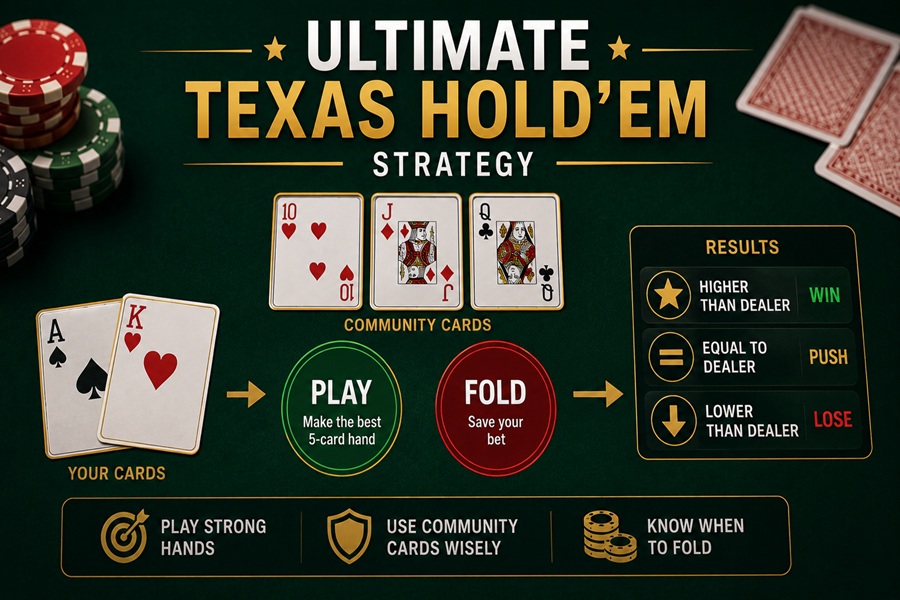
Quick answer: Ultimate Texas Hold’em strategy comes down to one repeating choice: when to make your Play bet. Raise 4x before the flop with any pair, any ace, and strong high-card hands. If you check, raise 2x on the flop with a hidden pair or better. If you still have not bet, raise 1x on the river when you have a hidden pair or the dealer has fewer than 21 cards that beat you. Otherwise, fold. Play this correctly and the house edge sits near 2.2% of your Ante.

You are not bluffing the dealer. You cannot fold them out. Every hand ends in a showdown or a fold by you. So the game is pure math. Here is the plan.

How does Ultimate Texas Hold’em work?

You play against the dealer, not other players. You post two equal bets to start, the Ante and the Blind, plus an optional Trips side bet.

Then you get one, and only one, chance to make a Play bet:

  • Before the flop, you may raise 4x your Ante or check.
  • After the flop, if you checked, you may raise 2x or check.
  • After the river, if you still have not bet, you may raise 1x or fold.

You bet once. The size depends only on how early you commit. Earlier means bigger, because a strong hand is worth more money in the pot before the board can hurt it.

Should you raise 4x before the flop?

This is where most of your long-term edge lives. Raising strong hands to the max preflop is the single biggest driver of good results.

Raise 4x with any of these starting hands:

  • Any pocket pair, from 3-3 up. Even small pairs are favorites heads-up against the dealer.
  • Any ace, including ace-two offsuit. Checking an ace is the most common and costly mistake in the game.
  • Any king with a suited kicker (K-2 suited and up) or K-5 offsuit and up.
  • Queen hands: Q-6 suited and up, or Q-8 offsuit and up.
  • Jack hands: J-8 suited and up, or jack-ten offsuit.
  • Ten hands: T-8 suited and up.
  • Suited connectors from 5-4 suited and up.

Check everything else and wait for the flop.

One rule to burn in: there is no useful 3x raise. Optimal play is 4x or check before the flop. Some tables list a 3x option, but the math almost never favors it. Analysts have shown you raise 4x on roughly 38% of hands and check the rest.

What should you do on the flop?

You only reach a flop decision if you checked preflop. Now three community cards are out. You may raise 2x or check again.

Raise 2x when you have:

  • Two pair or better.
  • A hidden pair. That means a pair made with at least one of your hole cards, not a pair sitting on the board for everyone.
  • Four to a flush that includes a hole card of ten or higher.

If none of that applies, check. You are not protecting a hand from bluffs here. You are only measuring your chance of beating the dealer, so betting a weak edge just donates money.

How do you play the river? The 21-out rule

The river is the trickiest spot, and the one that separates disciplined players from the rest. If you have not bet yet, you now choose: raise 1x or fold and lose your Ante and Blind.

Bet 1x if either of these is true:

  • You have a hidden pair or better.
  • The dealer has fewer than 21 outs to beat you.

That second point is the famous 21-out rule. Here is how it works in plain terms.

After the river, 45 unseen cards remain that could be the dealer’s hole card. Count how many of them would give the dealer a hand that beats yours. Those are the dealer’s “outs.”

  • If 21 or more of those cards beat you, folding loses less over time.
  • If fewer than 21 beat you, betting 1x is the better play.

You do not need to nail this to the exact card in real time. The point is to fold only your genuinely hopeless hands and bet the rest. When in doubt on a borderline spot, most weak hands still clear the bar for a 1x bet.

What is the house edge in Ultimate Texas Hold’em?

Low, when you play well. Punishing, when you do not.

Measure Figure
House edge on the Ante (perfect play) About 2.2%
Element of risk (edge vs. total money bet) About 0.5%
House edge with sloppy play Can climb toward 14%

Both of the first two numbers describe the same reality from different angles. Because you often wager around four Antes per hand, the edge relative to your total action is small, near half a percent. That makes Ultimate Texas Hold’em one of the better-value table games available.

The warning is real, though. Calling too wide on the river and failing to raise strong hands preflop are the two leaks that inflate that edge fast. Discipline keeps you near the theoretical floor.

Are the Trips and Blind bets worth it?

They are two very different things.

The Blind bet is mandatory and pays a bonus scale when you win with a straight or better. A royal flush pays a headline 500 to 1. If you win with less than a straight, the Blind simply pushes. You do not control this bet, so there is nothing to strategize.

The Trips bet is an optional side bet based only on your final five-card hand strength, win or lose. It offers flashy payouts but carries its own, higher house edge. Experienced players in poker forums are blunt about it: side bets like Trips are entertainment, not value. Skip them if you are playing to minimize losses.

What is the biggest mistake players make?

Checking strong hands preflop.

The cost of missing a 4x raise you should have made is far larger than the cost of checking a marginal hand. When your cards qualify, take the 4x. That aggression, applied only to the right hands, is where the strategy earns its keep.

The second biggest leak is river discipline. It is easy to memorize the 21-out rule and hard to apply it when a hand feels close. Trust the math over the feeling.

Frequently asked questions

What hands do you raise 4x in Ultimate Texas Hold’em?

Any pair, any ace, most king and queen hands, strong jack and ten hands, and suited connectors from 5-4 up.

Is there a 3x raise in Ultimate Texas Hold’em?

The option may exist at some tables, but optimal strategy never uses it. Play 4x or check preflop.

What is the 21-out rule?

On the river, bet 1x unless 21 or more of the 45 unseen cards would give the dealer a winning hand.

What is the house edge?

About 2.2% of the Ante with perfect strategy, or roughly 0.5% relative to your total money bet.

Can you beat the dealer with a bluff?

No. The dealer never folds. Every hand goes to showdown or you fold, so strategy is entirely about your own bets.

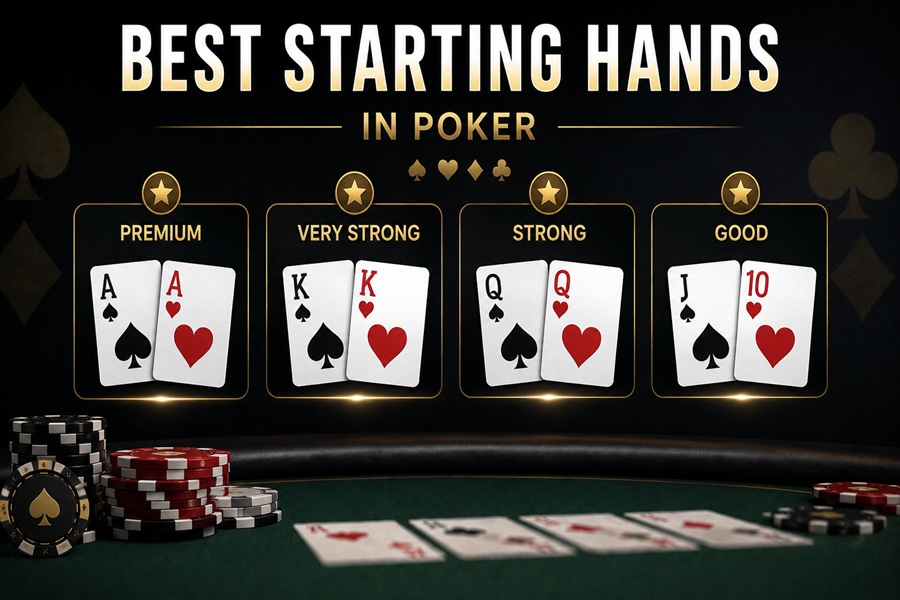
The best starting hand in poker is pocket aces (A-A), followed by pocket kings, pocket queens, pocket jacks, and ace-king suited. These premium hands win the most before the flop and hold up under pressure. In Texas Hold’em there are 169 distinct starting hands, but only a small group is strong enough to play from anywhere at the table.

Your two hole cards are the foundation of every decision that follows. Pick them well and the rest of the hand gets easier. Here is the ranking, the reasoning, and the one factor that changes everything.

What is the best starting hand in poker?

Pocket aces. Every time.

Before the flop, A-A beats every other hand statistically. Heads-up against a single random hand, it wins around 80% of the time. That is dominant, though not unbeatable, and it is why you play it aggressively.

The catch: aces win less often as more players see the flop. At a full table, someone can catch a lucky board. So the goal with aces is usually to thin the field by raising, not to trap a crowd.

What are the top 10 starting hands in Texas Hold’em?

Here is the broadly agreed ranking of the strongest hands, with rough heads-up win rates and a note on each. “Suited” means both cards share a suit. “Offsuit” means they do not.

Rank Hand Win rate (heads-up) Note
1 A-A ~85% The best. Raise and thin the field.
2 K-K ~82% Second only to aces. Beware an ace on the flop.
3 Q-Q ~80% Strong, but overcards appear often.
4 J-J ~77% Powerful yet tricky. A coin flip against A-K.
5 A-K suited ~67% The best drawing hand. Big upside, needs to connect.
6 T-T ~75% The best pair with no ace or face card.
7 A-K offsuit ~65% Same power as suited, slightly less flush upside.
8 A-Q suited ~66% Strong, but respect A-K.
9 9-9 ~72% A solid pair that flops sets and overpairs.
10 A-J suited ~65% Playable and pretty, but easily dominated.

Two ideas to take from this table:

  • Pairs rank high because they are already a made hand. They do not need the board to cooperate.
  • Suited beats offsuit, but only by a little. The flush it adds is worth roughly a couple of percent, not a transformation.

Why are pocket pairs so strong?

Because they start ahead. A pair does not need to improve to beat unpaired hands.

A pocket pair also has a hidden weapon: the set. If you flop a third card of your rank, you have three of a kind that opponents rarely see coming. Holding J-J on a ten-high board against ace-ten is exactly the spot where big money changes hands.

The trade-off is that middle and small pairs get nervous when overcards hit. Jacks and tens are the classic example. They crush random hands but lose to the three pairs above them, and they are only even money against ace-king. Play them with confidence, but be ready to fold when the board and the betting scream danger.

Which hands are premium, and how rare are they?

Poker players group starting hands into tiers. The tightest, safest group is the premium tier: hands you can play profitably from any seat.

Tier Hands When to play
Premium A-A, K-K, Q-Q, J-J, A-K, A-Q suited From any position
Strong T-T, 9-9, A-Q offsuit, A-J suited, K-Q suited From middle and late position
Speculative Small pairs, suited connectors, suited aces Mostly late position, cheaply

Premium hands are rare, which is the whole reason patience pays. Consider the odds:

  • You are dealt pocket aces about once every 221 hands.
  • You are dealt tens or better about once every 43 hands.

Those numbers explain why tight players can sit through long dry spells. Waiting is a real cost, but folding weak hands is what protects your stack for the moments that matter.

How does position change which hands to play?

This is the factor most beginners miss, and the one experienced coaches stress hardest. A starting hand does not have a fixed value. Where you sit changes it completely.

Acting later is a huge advantage. You see what everyone does before you decide, so you play with more information.

  • Early position (first seats after the blinds): stick to premium hands. The top of the ranking is your floor here, not your ceiling.
  • Middle position: widen a little to include strong hands and a few speculative ones.
  • Late position (near the button): open up. You can profitably play suited connectors, smaller pairs, and suited aces because you control the hand.

A hand like king-queen suited proves the point. It is genuinely strong, yet many amateurs underplay it. Played aggressively from good position, it makes strong hands and quiet profit. Played timidly from early position, it leaks money.

Do the best starting hands change in other poker games?

Yes. This ranking is for Texas Hold’em.

Omaha uses four hole cards and requires you to use exactly two, so hand values shift dramatically. Double-suited hands with connected cards like A-A-K-K become the giants there. In lowball games like Razz or 2-7, the “best” hand is the lowest one, flipping the logic entirely.

So treat this list as the Hold’em foundation. The instinct it builds, favoring pairs, high cards, and position, carries over. The exact rankings do not.

What are the worst starting hands?

The bottom of the pile is seven-two offsuit. The cards cannot make a straight together, do not share a suit, and are low. It is the classic auto-fold.

Other weak holdings include unconnected, unsuited low cards like 8-3 offsuit and 9-4 offsuit. They rarely connect with the board in a way that wins. Muck them and wait.

Frequently asked questions

What is the number one starting hand in poker?

Pocket aces (A-A). It is the strongest hand before the flop in Texas Hold’em.

How many starting hands are there in Texas Hold’em?

169 distinct hands, made up of 13 pocket pairs, 78 suited combos, and 78 offsuit combos, for 1,326 total two-card combinations.

Is ace-king a good starting hand?

Yes. Ace-king is the best drawing hand and a premium holding, especially suited. It needs to connect with the board to reach its full value.

How often do you get pocket aces?

About once every 221 hands.

Does suited really matter?

It helps, adding flush potential worth a few percent, but it does not turn a weak hand into a strong one on its own.

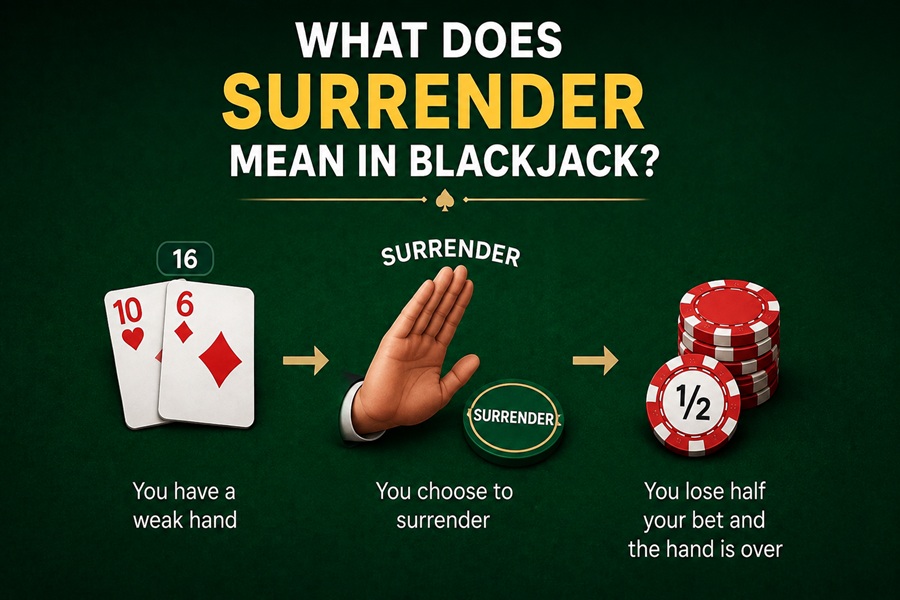
Surrender in blackjack means giving up your hand and forfeiting half your bet instead of risking the whole thing. You use it on weak hands that are likely to lose. Rather than fighting a losing spot, you fold, keep half your wager, and move on. Used correctly, it lowers the house edge and stretches your bankroll.

Think of it as a smart exit, not a white flag. Here is how it works and when to pull the trigger.

What does surrender mean in blackjack?

Surrender is an optional rule that lets you quit a hand early. You give up half your bet and keep the other half. The hand is over.

You only get the choice after seeing your first two cards and the dealer’s upcard. If the situation looks grim, and losing more than half your bet on average is likely, surrendering cuts the damage.

The guiding principle is straightforward. If your hand has less than a 50 percent chance of winning, surrender becomes worth considering. Losing half a bet beats losing a whole one most of the time in those spots.

What is the difference between early and late surrender?

This is the part that matters most, and the part casual players get wrong. There are two versions, and they are worlds apart in value.

Feature Early surrender Late surrender
When you decide Before the dealer checks for blackjack After the dealer checks for blackjack
Dealer has a natural You still keep half your bet You lose your full bet
Value to the player Large, cuts the house edge sharply Small but still useful
How common Very rare, nearly extinct The standard version today
House edge reduction About 0.62 percent Only a small fraction

Early surrender lets you fold before the dealer peeks for blackjack. Even if the dealer turns out to have a natural, you still walk away with half your bet. That protection is powerful, which is exactly why casinos removed it from almost every table.

Late surrender is the version you will actually find. You can only surrender after the dealer checks and does not have blackjack. If the dealer does have a natural, the hand is already lost, and you cannot surrender out of it.

Blackjack strategy sites and long-time players are blunt about this. If you are unsure which version a table offers, assume late surrender. Early surrender is so rare that when it appears at a live table, it is often a dealer mistake rather than a house rule.

When should you surrender in blackjack?

Surrender only helps in a handful of ugly spots. Reach for it on hard totals that are heavy underdogs against a strong dealer upcard.

For the common late-surrender game, the classic spots are:

  • Hard 16 against a dealer 9, 10, or ace. A pair of 8s is the exception, since splitting is usually better.
  • Hard 15 against a dealer 10. Against a dealer ace, surrender too if the dealer hits soft 17.
  • Hard 17 against a dealer ace, but only when the dealer hits soft 17.

Everything else, you play out. Surrender is a scalpel, not a hammer. Use it in those narrow cases and nowhere else.

To picture why it pays, take a hand of 9-7 for 16 against a dealer 10. Play it out and you lose more than half your bet on average across many hands. Surrender and you lose exactly half, guaranteed. Over hundreds of hands, that difference adds up.

What is composition-dependent surrender?

Here is a nuance the top guides usually skip, and one that separates a casual player from a sharp one.

Not all 16s are the same. A 16 made of 9-7 behaves differently from a 16 made of 8-8, and both differ from a 10-6. The exact cards in your hand slightly change the odds, because they remove specific cards from the remaining deck.

In single-deck games with certain rules, this can flip a decision. You might surrender a 9-7 but play out an 8-7 for 15, even though the totals are close. There are more than a dozen such exceptions.

The honest takeaway, echoed by experienced players in strategy communities: the edge from composition-dependent surrender is tiny and the rules are fiddly. Newer players are better off learning the standard total-based spots first and leaving the fine print to veterans.

How do you signal a surrender at the table?

At a live table, you say it out loud and back it with a hand signal.

  • Say “surrender” clearly to the dealer.
  • Draw a horizontal line behind your bet with your finger, as if cutting it off.

Online, there is usually a dedicated surrender button that appears only when the move is available. If you do not see the option, the table does not offer it.

What are the pros and cons of surrender?

Surrender is a genuine advantage, but it comes with trade-offs. Players in forums debate its feel as much as its math.

The upside:

  • It lowers the house edge when used correctly.
  • It saves half your bet in spots where you were likely to lose the whole thing.
  • It stretches your bankroll. For every two hands you surrender, you save roughly enough for one more bet, so you play longer.

The downside:

  • It reduces the excitement. No one enjoys folding a hand, even when the math approves.
  • It is easy to misuse. Surrendering good or borderline hands throws away value fast.
  • It is hard to find. Early surrender is nearly gone, and many tables offer no surrender at all.

Which games offer surrender?

Surrender shows up most often in games dealt from six or eight decks. Single-deck and double-deck tables rarely offer it.

You will also find it on many online blackjack tables and electronic table games, more reliably than at brick-and-mortar tables in some regions. When a table does offer it, that is a small point in the player’s favor, so it is worth seeking out alongside a 3-to-2 payout.

Frequently asked questions

What does surrender mean in blackjack?

It means folding your hand and giving up half your bet to avoid risking the full amount on a likely losing hand.

When should I surrender in blackjack?

On heavy underdog hands, mainly hard 16 against a dealer 9, 10, or ace, and hard 15 against a dealer 10.

Is early or late surrender better?

Early surrender is far better for the player, but it is nearly extinct. Late surrender is the common version and still helps.

Does surrender lower the house edge?

Yes. Early surrender cuts it by about 0.62 percent. Late surrender helps by a smaller amount.

Can I surrender after hitting?

No. Surrender is only available on your first two cards, before you take any other action.

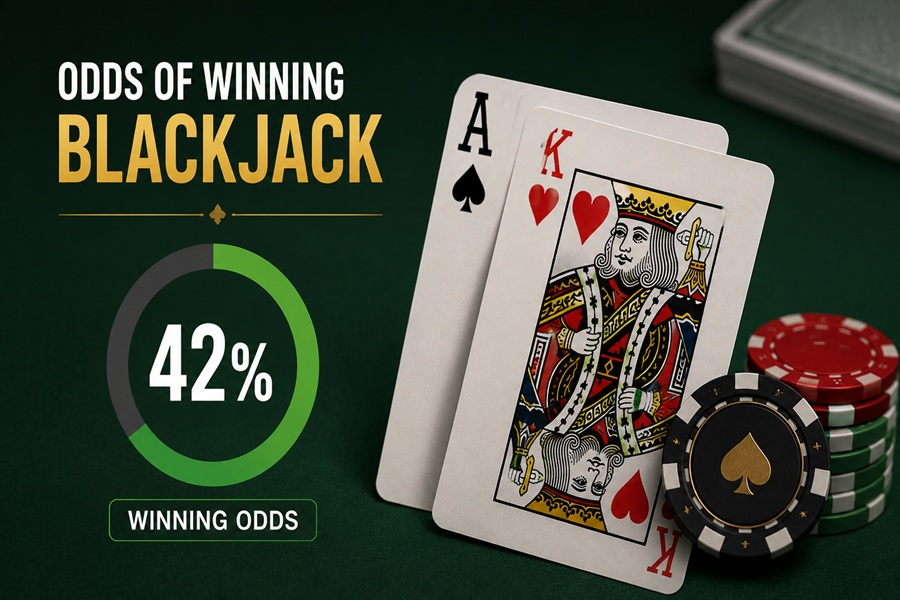
In a standard blackjack game, players win roughly 42 to 43 percent of hands, the dealer wins about 49 percent, and the remaining 8 to 9 percent end in a push (a tie). With perfect basic strategy, the house edge drops to around 0.5 percent, and under the best rules it can fall near 0.2 percent. That makes blackjack one of the best bets on the casino floor.

Those headline numbers hide a lot of useful detail. Here are the real odds, broken down by outcome, by hand, and by rule.

What are the odds of winning a hand of blackjack?

The player is a slight underdog on any single hand. The three outcomes break down like this.

Outcome Approximate chance
Player wins 42 to 43 percent
Dealer wins 49 percent
Push (tie) 8 to 9 percent

Why is the player behind? One structural reason. The player always acts first. Bust your hand and you lose immediately, even if the dealer would have busted moments later. That “player busts first” rule is the single biggest source of the house’s built-in edge.

The good news: the gap is small, and skill closes most of it.

What is the house edge in blackjack?

The house edge is the casino’s long-term advantage, expressed as a percentage of every bet.

  • With basic strategy: around 0.5 percent. For every 100 units you wager, you lose about 50 units of expected value over time.
  • Under the best rules: as low as roughly 0.2 percent.
  • Without strategy: 2 percent or higher, depending on how loosely you play.

Put that against other casino games and blackjack shines. European roulette carries a house edge near 2.7 percent, more than five times the blackjack figure for a strategy player. This is why long-running blackjack forums and communities keep repeating the same advice: learn basic strategy first, everything else second.

What are the odds of being dealt a blackjack?

A natural blackjack, an ace with any 10-value card on your first two cards, comes up about 4.8 percent of the time. That is close to 1 in every 21 hands.

It pays a bonus, usually 3 to 2. Bet 10 and collect 15.

Here is the catch that costs casual players the most. Many tables now pay 6 to 5 instead. That single change raises the house edge by about 1.39 percent, which is enormous relative to the 0.5 percent you started with. On a 6-to-5 table, a natural pays 12 instead of 15 on a 10-unit bet. Always find the 3-to-2 game.

What are your odds of busting when you hit?

Your bust risk depends entirely on your current total. This table shows the chance of going over 21 if you take one more card on a hard hand.

Your hard total Chance of busting if you hit
11 or lower 0 percent
12 31 percent
13 39 percent
14 56 percent
15 58 percent
16 62 percent
17 69 percent
18 77 percent
19 85 percent
20 92 percent

This is why strategy tells you to stand on stiff totals in the right spots. Hitting a 16 busts you nearly two times in three. Hitting anything 11 or below can never bust you, which is why those totals are automatic hits or doubles.

What are the odds of the dealer busting?

The dealer’s bust chance hinges on their upcard. Weak upcards bust often. Strong upcards rarely do. These are approximate figures for a game where the dealer stands on soft 17.

Dealer upcard Approximate bust chance
2 35 percent
3 37 percent
4 40 percent
5 42 percent
6 42 percent
7 26 percent
8 24 percent
9 23 percent
10 21 percent
Ace 17 percent

Read the pattern. A dealer showing 4, 5, or 6 busts around 40 percent of the time. That is why you stand on a stiff hand and let the dealer take the risk. A dealer showing 9, 10, or ace busts only about one time in five, so you have to build your own total higher to compete.

Which rules move the odds the most?

Not all blackjack tables are equal. The rules on the felt can swing the house edge by a full percentage point or more. Here is how the big ones cut.

Rule Effect on the player
Blackjack pays 3 to 2 Baseline, good for you
Blackjack pays 6 to 5 Adds about 1.39 percent to the house edge
Dealer stands on soft 17 Helps you by about 0.2 percent
Dealer hits soft 17 Hurts you by about 0.2 percent
Double after split allowed Helps you
Surrender offered Helps you
Fewer decks Generally helps you

Two tables can look identical and carry very different odds. Before you sit, check the payout, the soft-17 rule, and the deck count. Those three details tell you most of what you need to know.

Does card counting really change the odds?

Yes, but modestly and with effort.

Card counting tracks the ratio of high to low cards left in the shoe. When many 10-value cards and aces remain, the player has a small edge, because naturals and strong hands become more likely. Counters raise their bets in those moments.

A few honest points, the kind you will read from experienced players in forums rather than from casino marketing:

  • Counting is legal. It is not cheating. But casinos are private businesses and may ask a suspected counter to leave.
  • The edge a skilled counter gains is small, often a fraction of one percent. It rewards discipline and volume, not luck.
  • It does nothing for you on a single hand. It is a long-run betting strategy, not a magic trick.

Can you actually win at blackjack?

Over a single session, absolutely. Over a lifetime, the math is a headwind.

The house edge is a long-run average. In the short term, variance rules. A player can hit a hot streak and walk away well ahead, which is exactly why casinos set table limits: to stay solvent through those streaks while the edge grinds in their favor over millions of hands.

So the realistic framing is this. Blackjack gives you the best odds of any common table game. Basic strategy shrinks the house edge to near nothing. From there, whether you win tonight comes down to variance. Whether you win over years comes down to the small edge that never fully disappears.

Frequently asked questions

What percentage of blackjack hands does the player win?

About 42 to 43 percent, with roughly 8 to 9 percent ending in a push.

What are the odds of getting a blackjack?

Around 4.8 percent, or about 1 in 21 hands.

Is blackjack the best odds in the casino?

For a strategy player, yes. Its house edge of about 0.5 percent beats roulette, slots, and most other table games.

Do more decks make the odds worse?

Generally, yes. Fewer decks tend to favor the player, though the difference is small.

Does basic strategy guarantee a win?

No. It minimizes the house edge to about 0.5 percent, but it cannot remove the casino’s advantage entirely.

A Global Poker bonus code unlocks the site’s welcome package for new players. The standard offer gives you free Gold Coins when you register and a boosted first purchase, commonly 150,000 Gold Coins for around $10 plus 30 free Sweeps Coins. Gold Coins are for fun play only. Sweeps Coins are the currency you can redeem for cash prizes or gift cards. Enter the code during sign-up, and note that exact amounts and availability change by state and over time.

That is the short version. The important part is understanding how the two-coin system works, because it is the whole reason the bonus exists.

What is a Global Poker bonus code?

It is a short code you enter when you create an account or make your first coin purchase. The code links your account to a specific promotion.

Global Poker runs on a sweepstakes model, not real-money gambling. That structure is why it operates legally in most US states. The bonus code is how the platform welcomes new players into that model with free currency.

Codes are often tied to specific partners and promotions, so you may see different codes floating around. Always confirm the current code and its terms before you sign up.

Use bonus code [BONUS CODE] during registration to claim the current welcome offer.

How does the two-coin system work?

This is the single most important thing to understand before you claim anything. Global Poker uses two separate currencies.

Currency What it is Can you redeem it?
Gold Coins (GC) Play money for casual games No, purely for fun
Sweeps Coins (SC) Promotional currency Yes, for cash prizes or gift cards

You buy Gold Coins if you want. You never buy Sweeps Coins directly. Instead, SC arrive as a bonus attached to a Gold Coin purchase, or through free methods like giveaways and mail-in requests. Winning with Sweeps Coins is what can be redeemed.

This split is what keeps the model legal. You are always able to play for free, and no purchase is ever required to receive Sweeps Coins.

What does the Global Poker welcome offer include?

The welcome package generally has two parts: a free sign-up bonus and a boosted first purchase.

Part What you typically get
On registration (free) A batch of free Gold Coins, no purchase needed
First purchase (optional) Around 150,000 Gold Coins for roughly $10, plus 30 free Sweeps Coins

A few honest points that reviewers and long-time players raise:

  • The free sign-up amount and the exact first-purchase discount vary by state and change over time. Treat any specific figure as a snapshot, not a guarantee.
  • The first-purchase deal is usually framed as a discount, sometimes described as a 200% boost, on a package that normally costs more.
  • You will likely need to verify your identity before making a purchase or redeeming, using a document like a driver’s license or passport.

Always check the current numbers on the official site before you decide.

How do you claim the Global Poker bonus?

The process is quick, usually a few minutes start to finish.

  1. Visit the official Global Poker site and choose to register.
  2. Enter your details and the bonus code [BONUS CODE] where prompted.
  3. Confirm you meet the age requirement of 21 or older and that you are in an eligible location.
  4. Verify your email through the link Global Poker sends you.
  5. Collect your free sign-up Gold Coins, which land in your account automatically.
  6. Optionally, complete identity verification and make the first purchase to claim the boosted package and free Sweeps Coins.

That is it. You can play immediately with your free coins, with no obligation to buy.

Can you get Sweeps Coins without paying?

Yes. This is central to how the model stays legal, and it is worth knowing.

Free ways to collect Sweeps Coins have historically included:

  • Daily login bonuses, which can build over consecutive days of activity.
  • Social media giveaways and community promotions.
  • Mail-in requests, the traditional no-purchase-necessary route.

The catch worth flagging: these free methods and their terms change. Some request routes have been scaled back over time. Check the current promotions page for what is active now.

What is the playthrough and redemption process?

Before you can redeem Sweeps Coins, you have to play them.

  • Playthrough: Sweeps Coins usually carry a light requirement, often playing through each SC one time before it becomes redeemable.
  • Minimum redemption: There is typically a low minimum, commonly around 10 SC, to cash out for a gift card or prize.
  • Withdrawals: Global Poker is generally known for not charging withdrawal fees.

Compared with many social casinos, this is a relatively player-friendly redemption setup. Still, always read the current terms, because thresholds shift.

Is Global Poker available in your state?

Not everywhere, and this is changing fast. This is the part most bonus articles bury, and it matters more than any coin figure.

Global Poker operates in most US states but is restricted in several. It has also exited California following state legislation targeting sweepstakes platforms, and it remains unavailable in a number of other states. The list of excluded states has been growing as more legislatures act.

Because the legal picture is moving, do not assume the offer is open to you. Confirm availability for your specific state on the official site before you sign up. You must also be 21 or older.

Is Global Poker legit and safe?

By reputation, yes. It is one of the larger and longer-running social poker platforms, part of a family of well-known sweepstakes sites, with a busy player pool at most hours.

A balanced view from player reviews:

  • Upsides: steady game traffic, no withdrawal fees, a genuine free-to-play path, and a real poker focus rather than only slots.
  • Downsides: the welcome offer is modest compared with some rivals, payment options are limited, and Sweeps Coins cannot be converted back into Gold Coins.

As with any platform involving money, play within a budget and treat it as entertainment. If gambling ever stops feeling fun, step away and seek support resources in your area.

Frequently asked questions

Do you need a bonus code for Global Poker?

The welcome offer is usually tied to a code entered at sign-up. Free sign-up coins may arrive without one, but the boosted package generally needs the code.

Is the Global Poker bonus really free?

The sign-up Gold Coins are free. The Sweeps Coins come free with a first purchase or through no-purchase methods like giveaways and mail-in requests.

How much is the Global Poker welcome offer?

It commonly centers on 150,000 Gold Coins for about $10 plus 30 free Sweeps Coins, but amounts vary by state and change over time.

Can I win real money on Global Poker?

You can win Sweeps Coins, which are redeemable for cash prizes or gift cards after meeting the playthrough requirement.

How old do you have to be?

You must be at least 21 to play.

Quick answer: Free casino slot games let you spin real slot machines using virtual credits instead of cash. There is no financial risk, and at most sites no download or signup is needed. You get the same games, graphics, and bonus features as the real-money versions. The one difference: you cannot win real money in demo mode. It is pure entertainment, and a smart way to learn a game before you ever bet a cent.

Here is how free slots work, where to find them, and how to get the most out of playing for fun.

What are free casino slot games?

They are digital slot machines you play for entertainment, not money.

Instead of real cash, you spin with a virtual credit balance. You still trigger free spins, hit bonus rounds, and land big wins. The numbers on screen just are not real money.

Run out of credits? Reload the page and your balance resets. There is no limit and no cost.

Do free slots play the same as real money slots?

Yes, and this surprises people. The demo runs on the exact same game engine as the paid version.

That means the same:

  • RTP, the long-term return rate built into the game.
  • Volatility, how often and how big the wins come.
  • Bonus features, free spins, multipliers, and special mechanics.
  • Graphics and sound, the full experience.

Every spin is decided by a Random Number Generator, so results are random and fair in both modes. The only thing missing in free play is the cash payout.

Do you need to download or register to play?

Usually not. This is one of the best parts.

Modern slots are built in HTML5, so they load right in your browser. Open a game on your phone or computer and it starts in seconds. Nothing installs on your device.

Most demo slots also skip registration entirely. You click and play. Only full online casinos and social casino accounts ask you to sign up first.

Where can you play free slot games for fun?

You have a few options, depending on what you want.

Where What it is Can you redeem prizes?
Demo mode Free versions on casino and review sites No, virtual credits only
Social casinos Free-play apps with fun currency No, purely for fun
Sweepstakes casinos Free-to-play with a promotional currency Sometimes, for prizes

Demo mode is the simplest. Play any game for free with no account.

Social casinos like the well-known Vegas-style apps give you a chip balance to play with for fun and community features.

Sweepstakes casinos sit in between. You play for free, but a promotional currency can sometimes be redeemed for prizes, with a no-purchase path required by law.

What types of free slots can you try?

All of them. Free play is the perfect place to sample every format before you commit.

  • Classic 3-reel slots. Simple, nostalgic, fruit-and-sevens style.
  • Video slots. Five reels, rich themes, layered bonus rounds.
  • Megaways slots. A shifting number of ways to win each spin, often thousands.
  • Cluster pays. Wins form from groups of symbols instead of lines.
  • Progressive jackpots. Prize pools that grow across a network. One famous progressive has paid out over a billion dollars in real-money play across its history.

Trying each format for free is the fastest way to learn how they differ.

Why play free slots before real money?

Even seasoned players use demo mode. It is a genuine tool, not just a toy.

  • Learn the game. See how the bonus round triggers and how the paytable works.
  • Feel the volatility. Find out if a slot pays often in small amounts or rarely in big ones.
  • Test without pressure. No budget to manage, no losses to chase.
  • Compare titles. Sample ten games in an hour and keep the ones you enjoy.

A common thread in slot communities: the players who try a game free first tend to understand it far better than those who dive straight into real bets.

Can you win real money on free slots?

No. This is the honest limit of free play.

In demo mode, every win is virtual. You cannot cash out, because you never put money in. The features all work and the wins still feel exciting, but the balance is not real.

To play for actual money, you need a funded account at a licensed real-money casino, and you must be of legal age in a place where online casino play is permitted. Free play is for fun and practice. Real play is a separate step with real risk.

Free slots vs real money slots

Here is the difference at a glance.

Feature Free slots Real money slots
Cost None Real deposit required
Signup Often none Required
Winnings Virtual only Real, if you win
Risk Zero Real money at stake
Game engine Identical Identical
Best for Fun, learning, testing Playing for cash

Frequently asked questions

Are free casino slot games really free?

Yes. You play with virtual credits and never spend money. Demo play is free entertainment.

Can I play free slots without downloading anything?

Yes. Games run in your browser on mobile or desktop. Nothing installs.

Do free slots have the same odds as real ones?

Yes. The demo uses the same RTP, volatility, and RNG as the real-money version.

Can I win real money playing free slots?

No. You can only win virtual credits in demo mode. Real money requires a funded account at a licensed casino.

Is playing free slots for fun legal?

Playing demo slots for entertainment is broadly legal, since no real money is involved. Real-money play depends on the laws where you live.

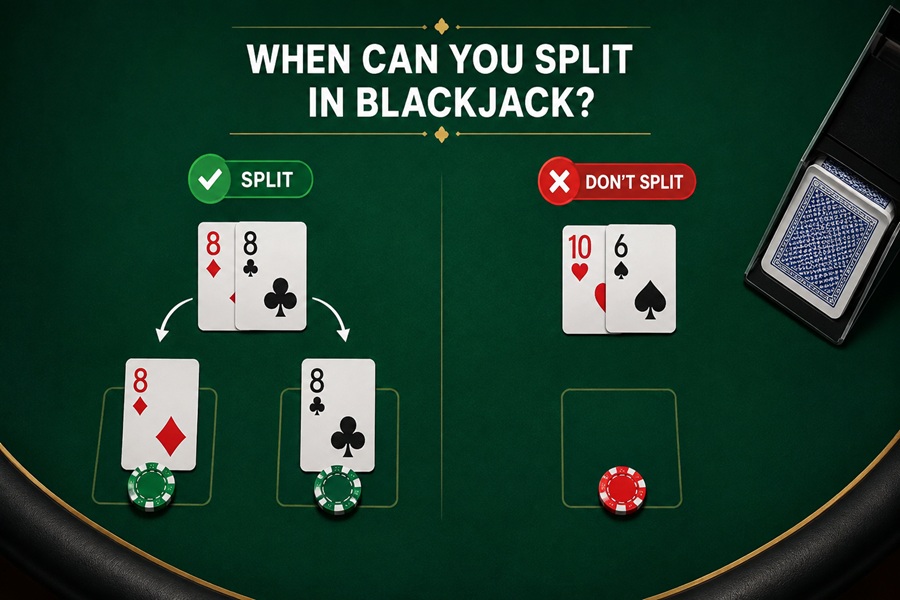
Quick answer: You can split in blackjack whenever your first two cards form a pair, meaning two cards of the same value. Splitting turns one hand into two separate hands. You place a second bet equal to your first, then play each hand on its own. The most trusted rule in the game is simple: always split aces and 8s, never split 5s or 10s.

That covers the “when you can.” The rest of this guide covers the “when you should,” pair by pair.

What does splitting actually mean in blackjack?

Splitting lets you break a pair into two hands.

Say you are dealt two 8s. Instead of playing a single hand worth 16, you separate them. Now you have two hands, each starting with an 8. You match your original bet on the new hand, so you have two bets and two chances to beat the dealer.

The dealer then gives each hand a new second card. You play the first hand to completion, then the second.

When can you split? The core rules

You can split only when your first two cards qualify and the table allows it. Here is what governs the move:

  • A matching pair. You need two cards of equal value. Two 7s, two queens, two aces.
  • Only on the opening hand. Once you hit, stand, or double, the option is gone.
  • A second, equal bet. Splitting always costs another wager the size of your first.
  • 10-value rules vary. Most casinos let you split any two 10-value cards, like a jack and a king. Some allow it only when the ranks match exactly.
  • Split aces get one card each. After splitting aces, you receive a single card per ace and cannot hit again. If that card is a 10, you have 21, but it counts as a normal 21, not a natural.

To signal a split at a live table, place your extra chips beside your original bet. Do not stack them on top. Some players also make a small V shape with two fingers on the felt.

Which pairs should you always split?

Two pairs are automatic. Every serious strategy chart agrees, and so does the wider blackjack community, from Wikipedia’s strategy pages to long-running forum threads.

Aces. Two aces total 2 or 12. Both are weak. Split them and each ace becomes the start of a strong new hand, with a real chance of drawing a 10 for 21.

Eights. Two 8s total 16, the worst hand in blackjack. Hit a 16 and you bust well over half the time. Splitting gives you two fresh hands that start from 8, which is a far better place to build from.

There is one advanced exception. Against a dealer ace, when the dealer hits soft 17 and surrender is offered, surrendering a pair of 8s can edge out splitting. In single-deck games with certain rules, the math can also shift. For nearly every table you will sit at, split them.

Which pairs should you never split?

Two pairs should stay together, always.

Tens. Two 10-value cards make 20. That is a near-winning hand. Splitting throws away a great total for two weaker ones. A common heuristic from experienced players: ask what a random 10 does to each half. Splitting a 20 into two 10s invites two mediocre hands instead of one excellent one.

Fives. A pair of 5s totals 10. That is a strong doubling hand, not a splitting hand. Split it and you start two hands from 5, both awkward. Double down or hit instead.

What about the tricky pairs?

Most pairs live in the middle. The right move depends on the dealer’s upcard. Use the table below as a starting reference. It follows standard basic strategy for a multi-deck game where the dealer stands on soft 17.

Your pair Split when dealer shows Otherwise
Aces (A-A) Always Always split
10s / faces Never Stand on 20
9s 2 through 9, except 7 Stand on 7, 10, or ace
8s Always Always split
7s 2 through 7 Hit
6s 2 through 6 Hit
5s Never Double or hit
4s 5 and 6 (if double after split is allowed) Hit
3s 2 through 7 Hit
2s 2 through 7 Hit

A few notes that most charts leave unexplained:

  • Nines skip the 7. You stand on 18 against a dealer 7 because the dealer likely holds a 10 for 17, and your 18 already wins. Split against 2 through 6, 8, and 9.
  • Fours only split with backup. A pair of 4s makes 8, a fine hitting total. Splitting is worth it only when you can double after the split, and only against a dealer 5 or 6.

How do table rules change when to split?

The chart above assumes common rules. Change the rules and some borderline plays flip. This is the part most beginner guides ignore.

Double after split (DAS). When a table lets you double down after splitting, low pairs like 2s, 3s, 4s, and 6s become more profitable to split. You gain a follow-up option that makes the split pay off.

No double after split (NDAS). Without that option, those same low pairs lose value. Splitting 4s or 6s becomes weaker, because you cannot press a strong follow-up card.

Re-splitting. Draw another matching card after a split and many casinos let you split again. Common limits are up to three or four total hands. Re-splitting 8s is a strong play when allowed.

Aces are special. Most tables limit you to one card per split ace and forbid re-splitting them. A few generous tables allow re-splitting aces, which is a rare bonus for the player.

Always check the felt and, at a live table, ask the dealer. Two tables that look identical can carry very different splitting rules.

How often do you even get to split?

Less often than you might think, which is why knowing the play matters when the chance comes.

The odds of being dealt any single pair from aces through nines sit at roughly half a percent each. The odds of two 10-value cards are higher, near 9 to 10 percent, because there are 16 such cards in the deck. So most of your split decisions will involve tens, and the answer there is almost always to stand.

Frequently asked questions

Can you split any two cards in blackjack?

No. You can split only a pair, meaning two cards of the same value.

Can you split two kings or a king and a queen?

Two kings, yes. A king and a queen depends on the casino. Some allow any 10-value split, others require matching ranks. Either way, you should stand on the 20.

How many times can you split in blackjack?

Usually up to three or four hands total, depending on the casino. Split aces are often limited to one split.

Do you have to bet more to split?

Yes. Each split requires a new bet equal to your original one.

Is splitting worth it?

When done correctly, yes. Splitting the right pairs turns weak hands into strong ones and lowers the house edge over time.

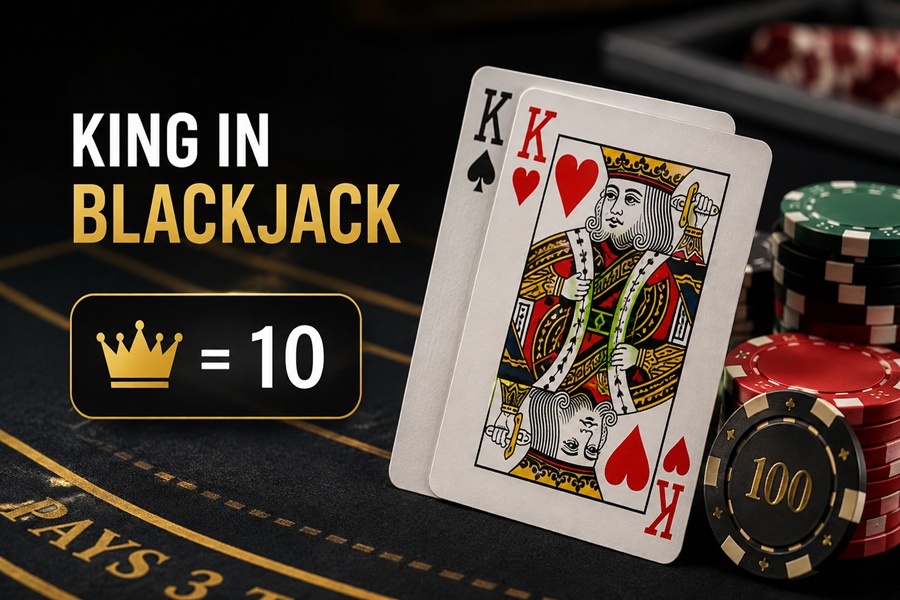
Quick answer: A king in blackjack is worth 10 points, always. The suit never matters. A king of hearts, spades, diamonds, or clubs all count the same. It shares this value with the queen, the jack, and the plain 10 card.

That single fact shapes more of your decisions than most beginners realize. Here is how the king really works, and how to play it well.

How much is a king worth in blackjack?

Ten. Every time.

Blackjack does not carry over the ranking system from poker. In poker, a king beats a queen, which beats a jack. At a blackjack table, that hierarchy disappears. All three face cards sit at the same value.

This trips up new players who come from poker. They assume a king must be “higher.” It is not. For scoring your hand, a king and a jack are identical.

What are all the card values in blackjack?

Blackjack uses a clean three-tier system. Once you learn it, adding up any hand takes a second.

Card Value
2 through 10 Face value (a 7 is 7, a 9 is 9)
Jack, Queen, King 10 points each
Ace 1 or 11, whichever helps more

The face cards plus the plain 10 form a group known as 10-value cards. There are 16 of them in a single 52-card deck. Four tens, four jacks, four queens, four kings.

Hold that number 16 in your head. It explains almost every smart play in the game.

Why does the king matter so much if it is only worth 10?

Because 10-value cards are the most common card you will see.

Nearly one in three cards in the deck is worth 10. So the safest assumption at the table is that the next card out, including the dealer’s hidden hole card, is a 10.

That assumption drives basic strategy:

  • If the dealer shows a weak upcard (4, 5, or 6), assume the hole card is a 10. That gives the dealer a stiff total near 14 to 16, and a strong chance to bust. You can play cautiously.
  • If the dealer shows a strong upcard (9, 10, or ace), assume a 10 underneath. Now the dealer is sitting on 19, 20, or a possible blackjack. You need to push your own total higher.

The king does not act alone here. But as one of those 16 ten-value cards, it is part of the math behind every hit and stand.

Is a king and an ace a blackjack?

Yes. King plus ace is a natural blackjack.

An ace paired with any 10-value card on your first two cards gives you 21 with two cards. That is the best possible hand.

A natural usually pays 3 to 2. Bet 10 units and you collect 15. The only way it does not win outright is if the dealer also has a natural, which results in a push (a tie, and you keep your bet).

Two quick cautions:

  • A king-ace is a natural. A three-card 21, like 5-6-king, is a good hand but not a natural. It normally pays even money, not 3 to 2.
  • Watch the payout on the felt. Some tables pay 6 to 5 on blackjack instead of 3 to 2. That underpays your best hand and quietly raises the house edge. Blackjack communities on Reddit and forums repeat one warning above all others: skip 6-to-5 tables whenever a 3-to-2 game is available.

What do you do with two kings?

You stand. Two kings make 20.

A total of 20 is one of the strongest hands in the game. You beat every dealer hand except a 21.

Some tables let you split two 10-value cards. You almost never should. Splitting a king pair breaks up a near-certain winner into two weaker starting hands. Players do it for excitement, and it usually costs them money over time.

There is a small rule wrinkle worth knowing. Many casinos let you split any two 10-value cards, such as a king and a queen. Others allow a split only when the ranks match exactly. Under that stricter rule, you could split king-king but not king-queen. Either way, the strategy answer is the same: do not do it.

Does the king change in different blackjack games?

The value stays at 10. What changes around it is the mix of cards.

Take Spanish 21. That version removes all four plain 10 cards from every deck. The face cards stay in, so kings, queens, and jacks are still worth 10. But there are fewer 10-value cards overall, which shifts the odds and the correct strategy. The rules add extra bonuses to make up for it.

The lesson: the king’s value is fixed, but the game around it is not. Always check the rule board before you sit down.

Where does the name and the face card even come from?

A short piece of history that most guides skip.

The name “blackjack” traces back to an early version of the game. Some tables paid a bonus for a hand that included the ace of spades and a black jack, meaning the jack of spades or clubs. That bonus faded away, but the name stuck. You do not need an actual black jack to make a blackjack today.

The face cards themselves are old. Kings appear in some of the earliest European decks. Queens replaced an earlier knight figure. The jack, once called the knave, sat below both. None of that lineage affects the modern point value, but it explains why a “king” outranks a “jack” everywhere except the one game where it does not.

Common mistakes players make with kings

  • Assuming a king beats a jack. In scoring, they are equal. Both are 10.
  • Splitting king pairs. You are trading a 20 for two weaker hands.
  • Confusing a natural with any 21. Only a two-card king-ace (or ten-ace) is a natural that pays the bonus.
  • Ignoring the payout rule. A king-ace on a 6-to-5 table pays less than it should.

Frequently asked questions

Is a king higher than a queen in blackjack?

No. Both are worth 10 points. There is no ranking between face cards.

How much is a king and a 5 worth?

Fifteen. The king counts as 10, plus the 5.

Can you split kings in blackjack?

Usually yes, but you should not. Two kings make 20, which is a strong standing hand.

Is king-ace the best hand in blackjack?

It is tied for the best. Any 10-value card with an ace on the first two cards is a natural blackjack.

Quick answer: Yes, McLuck is a legitimate sweepstakes social casino, not a scam. It is run by a real, traceable operator, uses standard identity checks and encryption, and player reviews skew positive on games and prize redemptions. The honest caveats: it is not a state-licensed real-money casino, it is unavailable in a growing list of states, and the most common complaint is slow payouts, almost always tied to unfinished account verification. Play it as entertainment, and verify your account early.

Here is the full, balanced picture so you can decide for yourself.

Is McLuck a real company or a scam?

It is a real company with a public trail, which is the first thing to check with any sweeps site.

McLuck launched in 2023 and is operated by B-Two Operations Limited, a registered company based in the Isle of Man, with reported offices in Estonia and a mail-in address in the United States for the free-entry route. This is a traceable operator, not an anonymous offshore brand.

It also does not stand alone. McLuck sits in a family of sister brands run by the same operator, including Hello Millions, MegaBonanza, and others. A track record across several live brands is one of the few real trust signals in this category, and McLuck has it.

How does McLuck actually work?

McLuck runs on the sweepstakes model, so it is important to understand that it is not a traditional gambling site.

It uses two currencies:

Currency What it is Redeemable?
Gold Coins (GC) For fun play only No
Sweeps Coins (SC) Promotional currency Yes, for gift cards or cash prizes

You never deposit or withdraw in the normal sense. You can optionally buy Gold Coin packages, which include bonus Sweeps Coins. You can also earn Sweeps Coins for free through daily logins, promotions, and a no-purchase mail-in route.

Because no purchase is ever required to play or win, McLuck operates under sweepstakes law rather than gambling law. That structure is what makes it legal in most states without a gambling license.

Is McLuck safe and secure?

On the security basics, it checks the expected boxes.

  • Encryption. McLuck uses SSL encryption to protect your data.
  • Identity verification. It requires KYC identity checks before your first redemption, the standard safeguard in this space. This confirms your identity, age, and location.
  • Geolocation. Location software blocks access from states where it does not operate.

None of this is unusual, and that is the point. McLuck follows the same safety playbook as the established operators in the category.

What do the common complaints reveal?

No platform is perfect, and the recurring gripes are worth knowing. The useful part is that they point to friction, not fraud.

  • Payout delays. This is the single most repeated complaint. In almost every case it traces back to players who had not completed identity verification before requesting a redemption. Finishing KYC early avoids most of it. Bank-transfer timing can also vary by institution.
  • Gated live chat. Some reviews note that live chat is limited to players who have made a purchase or reached VIP status, while email and the help center stay open to everyone.

Taken together, the reviews describe a mature sweeps operation. The complaints are about speed and support access, not about whether players can actually get their prizes.

Is McLuck legit but not licensed? What that means

This is the nuance that matters most, and it applies to the whole category.

McLuck does not hold a state gambling license. Neither does any US sweepstakes casino. That is not a red flag on its own, because the sweepstakes model is a different legal structure that does not require a gambling license. But it does mean McLuck is not a regulated real-money casino, and you should judge it as a social-sweeps platform, not as a licensed online casino.

In plain terms: legitimate within its category, but that category is not the same as a state-licensed casino.

Where is McLuck available?

In most US states, but the list of exclusions has been growing as sweepstakes regulation tightens.

McLuck is restricted in a number of states, and different sources report slightly different lists because the picture keeps changing. States commonly listed as excluded include Washington, Idaho, Nevada, Michigan, and several others, with more added over time.

Because availability is moving, do not assume the site is open where you live. Confirm current availability on the official McLuck site before signing up. You must also meet the minimum age, which is 18 or 21 depending on your state.

What is the verdict on McLuck?

Legit, with clear boundaries. Here is the balance.

In its favor:

  • A real, traceable operator with a family of established brands.
  • Standard encryption and mandatory identity verification.
  • Light redemption terms, with a low playthrough on Sweeps Coins.
  • Reviews that skew positive on games and prize payouts.
  • A genuine no-purchase path to play and win.

Worth weighing:

  • Not a state-licensed real-money casino.
  • Unavailable in a growing list of states.
  • Payout speed can lag, mostly due to unfinished verification.
  • Live chat is gated for some users.

Play responsibly

Sweepstakes gaming is meant to be entertainment, not income. Understanding how the sweeps model differs from real-money gambling does not make it risk-free.

Set your own limits, never treat it as a way to make money, and step away if it stops being fun. If you or someone you know needs support, the National Council on Problem Gambling helpline at 1-800-GAMBLER is available.

Frequently asked questions

Is McLuck Casino legit?

Yes. It is a real sweepstakes casino with a traceable operator, standard security, and mostly positive reviews. It is not a licensed real-money casino.

Can you win real money on McLuck?

You can win Sweeps Coins, which are redeemable for gift cards or cash prizes after you complete verification and meet a light playthrough.

Why is my McLuck payout delayed?

Most delays come from incomplete identity verification. Completing KYC early is the fix. Bank timing can also add a day or two.

Do you have to pay to play McLuck?

No. There is a no-purchase path to earn and redeem Sweeps Coins. Coin purchases are optional.

Is McLuck available in my state?

It is available in most states but restricted in a growing list. Check the official site for current availability.

Quick answer: No single casino is officially the “loosest,” because Nevada reports slot payback by area, not by individual casino. But the data is clear on where to look. The loosest slots in Las Vegas are off the Strip, in the Boulder Strip and North Las Vegas areas, where payback averages around 94% to 96%. The Strip is the tightest, closer to 91% to 93%. To find loose slots, get off the Strip and play the locals casinos.

Here is what the numbers actually say, and why the popular answer is often wrong.

What does “loosest slots” even mean?

A loose slot is one with a higher payback percentage, also called RTP. It returns more of the money wagered over time.

Payback is the opposite of the casino’s hold. A slot with 95% payback has a 5% house edge. The higher the payback, the “looser” the machine, and the better your long-run odds.

The key word is long-run. Even the loosest slot still favors the house on every spin. Loose only means the edge is smaller.

Where does the loose-slots data come from?

From the state, which makes Las Vegas unusually transparent about this.

Every casino in Nevada reports its slot results to the Nevada Gaming Control Board. Those figures show the percentage of wagers each casino kept as profit. The University of Nevada, Las Vegas compiles the data into a public picture of payback by region.

There is one crucial limitation. The reporting groups casinos by geographic area, such as the Strip, Downtown, Boulder Strip, and North Las Vegas. It does not break down individual casinos. So any article claiming a specific casino has an exact RTP is guessing. The honest answer works at the area level.

Which area has the loosest slots in Las Vegas?

Off the Strip, in the locals markets. This is where the data consistently points.

Area Slot payback How it ranks
Boulder Strip ~94% to 96% Loosest
North Las Vegas ~94% to 96% Loosest
Downtown Moderate Mixed
The Strip ~91% to 93% Tightest
Airport Near legal minimum Tightest

The Boulder Strip, the casinos along Boulder Highway and into Henderson, and North Las Vegas trade places at the top depending on the reporting period. Both sit well above the Strip.

Nevada sets a legal minimum payback of 75%, but real machines run far higher than that floor. The gap that matters is between the locals areas and the Strip, which can be several percentage points.

Why are Strip slots tighter?

Because the Strip pays for spectacle, and makes it back on the floor.

Strip casinos carry enormous costs for prime real estate, staffing, and the shows and attractions that draw tourists. They recover those costs partly through tighter slots.

Locals casinos play the opposite game. Chains that cater to regulars compete on value to keep neighborhood players coming back week after week. Looser machines are part of that pitch. That is the whole reason the biggest payback gap in the metro is between the locals areas and the Strip.

Is Downtown really looser than the Strip?

This is the myth worth correcting, and it is a fresh insight most guides get wrong.

For years the common wisdom was that Downtown, the Fremont Street area, paid better than the Strip. Recent Nevada data flips that. For several consecutive years, Strip slots have actually held less than Downtown slots, meaning the Strip paid slightly better than Downtown, not worse.

So the real story is not Downtown versus the Strip. The meaningful gap is between the North Las Vegas and Boulder locals casinos and everywhere touristy. If you repeat the old “Downtown is looser” line, you are working from outdated information.

Which casinos are in the loosest areas?

Since the data is by area, the practical move is to play casinos located in the loose zones. These locals-focused properties sit in the Boulder Strip and North Las Vegas areas, or carry long reputations for player-friendly slots.

  • Boulder Strip and Henderson: Boulder Station, Sunset Station, Green Valley Ranch, Sam’s Town.
  • North Las Vegas: locals casinos in that reporting zone, including long-standing spots like Jerry’s Nugget.
  • Off-Strip and Summerlin: Red Rock Resort, Rampart Casino.
  • Reputation for value: South Point, which markets itself to locals, and El Cortez Downtown, long known for historically loose slots. Ellis Island is famous more for its player-friendly table games than slots.

Treat these as strong bets based on area data and reputation, not as officially verified per-machine numbers, because those numbers do not exist publicly.

Does slot denomination affect looseness?

Yes, more than most players realize. Denomination is a bigger lever than casino choice for many people.

Higher denomination machines almost always pay back more than low ones.

  • Penny slots are the tightest by denomination. They are the most popular, so they carry the lowest payback. In the touristy areas, penny slots run especially tight.
  • Dollar and higher machines ($1, $5, $25) return more over time across years of Nevada data.

Even within the loose Boulder and North Las Vegas areas, penny slots pay less than higher denominations. If your bankroll allows, stepping up a denomination often does more for your odds than switching casinos.

Are the “loose slots near the entrance” stories true?

That one is folklore, repeated everywhere but never verified.

The theory says casinos place loose machines in high-traffic spots, near walkways, entrances, and table games, so passersby see wins and are tempted to play. It is a fun idea and a staple of casino forums, but there is no public data confirming it. Treat it as a story, not a strategy.

Modern slots also run on random number generators, so no machine is ever “due.” Past spins do not affect future ones.

How can you find loose slots in Vegas?

You cannot beat the house, but you can shift the odds a little in your favor with a few habits.

  1. Get off the Strip. Play the Boulder Strip, Henderson, or North Las Vegas locals casinos.
  2. Step up the denomination. Dollar and high-limit machines pay back more than pennies.
  3. Check high-limit rooms. Payback tends to be better where the stakes are higher.
  4. Match volatility to your goal. Low volatility stretches your session, high volatility chases big wins.
  5. Remember the ceiling. Even loose slots keep a house edge. Set a budget and stick to it.

Frequently asked questions

What casino has the loosest slots in Vegas?

No casino is officially the loosest, since Nevada reports by area. The loosest areas are the Boulder Strip and North Las Vegas locals casinos.

Are Strip slots loose or tight?

Tight. The Strip has the lowest slot payback in the metro, around 91% to 93%, because of its high operating costs.

Is it true Downtown has looser slots than the Strip?

Not anymore. Recent Nevada data shows the Strip actually paid slightly better than Downtown for several years running.

Do higher denomination slots pay more?

Yes. Dollar and high-limit machines have returned more than penny slots over years of Nevada data.

What is the loosest a Vegas slot can legally be?

There is no upper cap, but Nevada sets a legal minimum payback of 75%. Real machines run much higher.

Quick answer: Online casino slots for real money are RNG-driven games where you bet cash and can win cash. Every spin is random and independent. Two numbers decide how a slot behaves: RTP, the long-term return rate (usually 94% to 97%), and volatility, how often and how big wins land. The house always keeps an edge, so slots are entertainment with a real cost, not a way to make money. Play only at licensed casinos, where you are of legal age, and within a set budget.

Understanding the mechanics below is what separates informed play from spinning blindly. Here is how real-money slots really work.

How do online slots work?

At the core of every slot is a Random Number Generator, or RNG. It produces a random outcome for each spin, independent of the last one.

That independence matters. A slot has no memory. It is not “due” for a win after a cold streak, and it does not “cool off” after a jackpot. Each spin starts fresh.

Licensed slots use certified RNGs that independent testing labs verify for fairness. That certification is one of the main reasons to play only at regulated operators.

What is RTP in online slots?

RTP stands for Return to Player. It is the percentage of all wagered money a slot is designed to return over the long run.

An RTP of 96% means the game returns about $96 for every $100 wagered, averaged across millions of spins.

Three things to keep straight:

  • It is long-term. RTP describes the lifetime of a game, not your session. Anything can happen in an hour.
  • It is not a guarantee. A 96% RTP does not mean you get $96 back tonight. You might win big or lose it all.
  • The rest is the house edge. If RTP is 96%, the house edge is 4%. That gap is how the casino profits over time.

Most quality slots fall between 94% and 97%. You can usually find a game’s RTP in its information or paytable screen. Checking it before you play is a simple habit worth building.

What is slot volatility?

Volatility, also called variance, describes the rhythm of a slot’s payouts. It is separate from RTP.

Volatility How it pays Best for
Low Frequent, small wins Longer sessions, steady play
Medium A balance of both Most players
High Rare, large wins Big-win chasers with patience

Here is the key point many players miss. Volatility does not change the total return. Two slots can share the same 96% RTP and feel completely different, one drip-feeding small wins, the other silent for a hundred spins before a huge hit. RTP governs the long-run return. Volatility governs the ride.

Match volatility to your bankroll and mood. A small budget lasts longer on a low-volatility game. A high-volatility slot can drain a small balance fast while you wait for the big one.

What types of real money slots are there?

The lobby can look overwhelming. Most games fit a few categories.

  • Classic slots. Three reels, simple paylines, old-school feel.
  • Video slots. Five reels, immersive themes, layered bonus features.
  • Megaways slots. A changing number of ways to win per spin, sometimes over 100,000.
  • Cluster pays. Wins form from clusters of matching symbols rather than lines.
  • Progressive jackpots. A shared prize pool that grows until someone wins it, occasionally reaching into the millions.
  • Bonus buy slots. Games that let you pay extra to jump straight into the bonus round, where legal.

What slot features should you know?

The symbols and mechanics that drive wins are worth understanding before you bet.

  • Wilds. Substitute for other symbols to complete wins. Some also multiply.
  • Scatters. Pay based on your total bet and often trigger free spins, wherever they land.
  • Multipliers. Increase a win by a set factor, sometimes stacking during bonuses.
  • Free spins. Bonus rounds where you spin without wagering, often with boosted features.
  • Paylines. The patterns that pay. Activating more can mean more chances to hit, at a higher bet.

Can you actually win money on online slots?

Yes, people win real money on slots every day. But the math deserves honesty.

Because every licensed slot has a house edge, the game is designed for the casino to profit over time. You can absolutely win in a single session. Over the long run, the edge grinds against you.

That is why the sober framing matters, and why responsible operators and player communities repeat it: slots are entertainment, not an income strategy. Treat any winnings as a lucky bonus, not an expectation.

  • Set a budget before you spin, and stop when you hit it.
  • Use the deposit and time limits regulated casinos provide.
  • Never chase losses. The RNG does not owe you a comeback.
  • Play only when it is fun. If it stops being fun, step away.

Where are real money online slots legal?

Availability depends entirely on where you live, and the picture keeps changing.

In the United States, real-money online casino play is limited to a handful of regulated states, including New Jersey, Pennsylvania, Michigan, and West Virginia, among a few others. Outside those states, many players use social or sweepstakes casinos instead. Other countries have their own licensing systems.

Two non-negotiables before you play for real money:

  • Confirm that online casino play is legal where you are.
  • Play only at a licensed, regulated operator, and make sure you meet the legal age requirement.

Unlicensed offshore sites carry real risks around fairness and payouts. The certification and consumer protections at regulated casinos are the whole point.

How do you choose a good real money slot?

There is no way to beat a slot, but there are smarter ways to choose one.

  1. Check the RTP. Favor games at 96% or higher when you can.
  2. Match the volatility to your budget and patience.
  3. Read the features. Know how the bonus round triggers before you bet.
  4. Try it free first. Most real-money slots have a demo. Test the feel with no risk.
  5. Mind the bet size. Pick stakes that let your budget last.

Frequently asked questions

What is a good RTP for online slots?

Anything from 96% and up is generally considered good. Many quality slots sit between 94% and 97%.

Does higher volatility mean better payouts?

Not overall. High volatility means bigger but rarer wins. Total return is set by RTP, not volatility.

Are online slots rigged?

Licensed slots use certified RNGs tested by independent labs. They are random and fair. Unregulated sites are a different and riskier story.

Can you beat online slots with a strategy?

No system can overcome the house edge. Smart choices manage risk, but slots remain games of chance.

Do free demo slots have the same RTP as real money slots?

Yes. The demo uses the same engine, RTP, and volatility. Only the payout is virtual.