
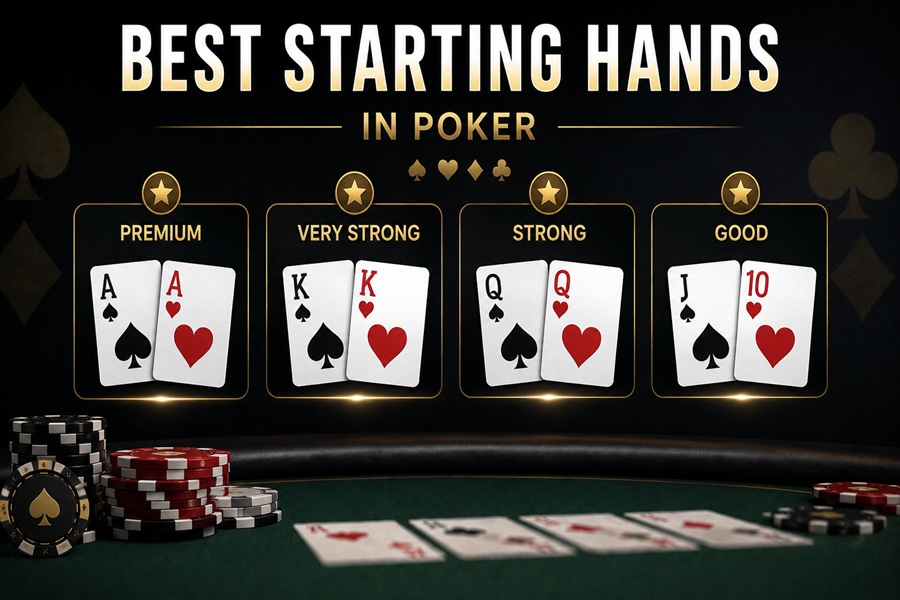
The best starting hand in poker is pocket aces (A-A), followed by pocket kings, pocket queens, pocket jacks, and ace-king suited. These premium hands win the most before the flop and hold up under pressure. In Texas Hold’em there are 169 distinct starting hands, but only a small group is strong enough to play from anywhere at the table.
Your two hole cards are the foundation of every decision that follows. Pick them well and the rest of the hand gets easier. Here is the ranking, the reasoning, and the one factor that changes everything.
What is the best starting hand in poker?
Pocket aces. Every time.
Before the flop, A-A beats every other hand statistically. Heads-up against a single random hand, it wins around 80% of the time. That is dominant, though not unbeatable, and it is why you play it aggressively.
The catch: aces win less often as more players see the flop. At a full table, someone can catch a lucky board. So the goal with aces is usually to thin the field by raising, not to trap a crowd.
What are the top 10 starting hands in Texas Hold’em?
Here is the broadly agreed ranking of the strongest hands, with rough heads-up win rates and a note on each. “Suited” means both cards share a suit. “Offsuit” means they do not.
| Rank | Hand | Win rate (heads-up) | Note |
|---|---|---|---|
| 1 | A-A | ~85% | The best. Raise and thin the field. |
| 2 | K-K | ~82% | Second only to aces. Beware an ace on the flop. |
| 3 | Q-Q | ~80% | Strong, but overcards appear often. |
| 4 | J-J | ~77% | Powerful yet tricky. A coin flip against A-K. |
| 5 | A-K suited | ~67% | The best drawing hand. Big upside, needs to connect. |
| 6 | T-T | ~75% | The best pair with no ace or face card. |
| 7 | A-K offsuit | ~65% | Same power as suited, slightly less flush upside. |
| 8 | A-Q suited | ~66% | Strong, but respect A-K. |
| 9 | 9-9 | ~72% | A solid pair that flops sets and overpairs. |
| 10 | A-J suited | ~65% | Playable and pretty, but easily dominated. |
Two ideas to take from this table:
- Pairs rank high because they are already a made hand. They do not need the board to cooperate.
- Suited beats offsuit, but only by a little. The flush it adds is worth roughly a couple of percent, not a transformation.
Why are pocket pairs so strong?
Because they start ahead. A pair does not need to improve to beat unpaired hands.
A pocket pair also has a hidden weapon: the set. If you flop a third card of your rank, you have three of a kind that opponents rarely see coming. Holding J-J on a ten-high board against ace-ten is exactly the spot where big money changes hands.
The trade-off is that middle and small pairs get nervous when overcards hit. Jacks and tens are the classic example. They crush random hands but lose to the three pairs above them, and they are only even money against ace-king. Play them with confidence, but be ready to fold when the board and the betting scream danger.
Which hands are premium, and how rare are they?
Poker players group starting hands into tiers. The tightest, safest group is the premium tier: hands you can play profitably from any seat.
| Tier | Hands | When to play |
|---|---|---|
| Premium | A-A, K-K, Q-Q, J-J, A-K, A-Q suited | From any position |
| Strong | T-T, 9-9, A-Q offsuit, A-J suited, K-Q suited | From middle and late position |
| Speculative | Small pairs, suited connectors, suited aces | Mostly late position, cheaply |
Premium hands are rare, which is the whole reason patience pays. Consider the odds:
- You are dealt pocket aces about once every 221 hands.
- You are dealt tens or better about once every 43 hands.
Those numbers explain why tight players can sit through long dry spells. Waiting is a real cost, but folding weak hands is what protects your stack for the moments that matter.
How does position change which hands to play?
This is the factor most beginners miss, and the one experienced coaches stress hardest. A starting hand does not have a fixed value. Where you sit changes it completely.
Acting later is a huge advantage. You see what everyone does before you decide, so you play with more information.
- Early position (first seats after the blinds): stick to premium hands. The top of the ranking is your floor here, not your ceiling.
- Middle position: widen a little to include strong hands and a few speculative ones.
- Late position (near the button): open up. You can profitably play suited connectors, smaller pairs, and suited aces because you control the hand.
A hand like king-queen suited proves the point. It is genuinely strong, yet many amateurs underplay it. Played aggressively from good position, it makes strong hands and quiet profit. Played timidly from early position, it leaks money.
Do the best starting hands change in other poker games?
Yes. This ranking is for Texas Hold’em.
Omaha uses four hole cards and requires you to use exactly two, so hand values shift dramatically. Double-suited hands with connected cards like A-A-K-K become the giants there. In lowball games like Razz or 2-7, the “best” hand is the lowest one, flipping the logic entirely.
So treat this list as the Hold’em foundation. The instinct it builds, favoring pairs, high cards, and position, carries over. The exact rankings do not.
What are the worst starting hands?
The bottom of the pile is seven-two offsuit. The cards cannot make a straight together, do not share a suit, and are low. It is the classic auto-fold.
Other weak holdings include unconnected, unsuited low cards like 8-3 offsuit and 9-4 offsuit. They rarely connect with the board in a way that wins. Muck them and wait.
Frequently asked questions
What is the number one starting hand in poker?
Pocket aces (A-A). It is the strongest hand before the flop in Texas Hold’em.
How many starting hands are there in Texas Hold’em?
169 distinct hands, made up of 13 pocket pairs, 78 suited combos, and 78 offsuit combos, for 1,326 total two-card combinations.
Is ace-king a good starting hand?
Yes. Ace-king is the best drawing hand and a premium holding, especially suited. It needs to connect with the board to reach its full value.
How often do you get pocket aces?
About once every 221 hands.
Does suited really matter?
It helps, adding flush potential worth a few percent, but it does not turn a weak hand into a strong one on its own.
