Category: Poker

  • Ultimate Texas Hold’em Strategy: The 4x, 2x, 1x Playbook

    Ultimate Texas Hold’em Strategy: The 4x, 2x, 1x Playbook

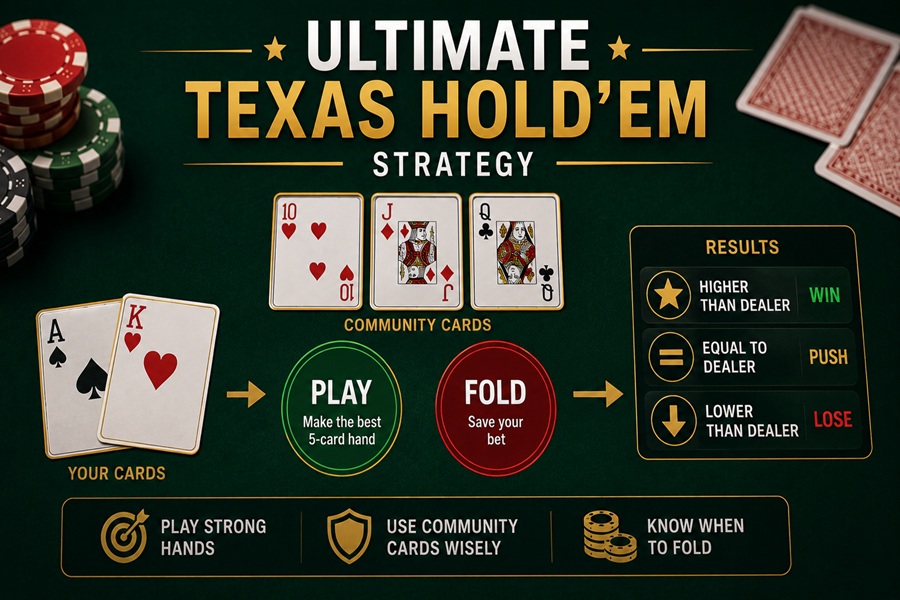
    Quick answer: Ultimate Texas Hold’em strategy comes down to one repeating choice: when to make your Play bet. Raise 4x before the flop with any pair, any ace, and strong high-card hands. If you check, raise 2x on the flop with a hidden pair or better. If you still have not bet, raise 1x on the river when you have a hidden pair or the dealer has fewer than 21 cards that beat you. Otherwise, fold. Play this correctly and the house edge sits near 2.2% of your Ante.

    You are not bluffing the dealer. You cannot fold them out. Every hand ends in a showdown or a fold by you. So the game is pure math. Here is the plan.

    How does Ultimate Texas Hold’em work?

    You play against the dealer, not other players. You post two equal bets to start, the Ante and the Blind, plus an optional Trips side bet.

    Then you get one, and only one, chance to make a Play bet:

    • Before the flop, you may raise 4x your Ante or check.
    • After the flop, if you checked, you may raise 2x or check.
    • After the river, if you still have not bet, you may raise 1x or fold.

    You bet once. The size depends only on how early you commit. Earlier means bigger, because a strong hand is worth more money in the pot before the board can hurt it.

    Should you raise 4x before the flop?

    This is where most of your long-term edge lives. Raising strong hands to the max preflop is the single biggest driver of good results.

    Raise 4x with any of these starting hands:

    • Any pocket pair, from 3-3 up. Even small pairs are favorites heads-up against the dealer.
    • Any ace, including ace-two offsuit. Checking an ace is the most common and costly mistake in the game.
    • Any king with a suited kicker (K-2 suited and up) or K-5 offsuit and up.
    • Queen hands: Q-6 suited and up, or Q-8 offsuit and up.
    • Jack hands: J-8 suited and up, or jack-ten offsuit.
    • Ten hands: T-8 suited and up.
    • Suited connectors from 5-4 suited and up.

    Check everything else and wait for the flop.

    One rule to burn in: there is no useful 3x raise. Optimal play is 4x or check before the flop. Some tables list a 3x option, but the math almost never favors it. Analysts have shown you raise 4x on roughly 38% of hands and check the rest.

    What should you do on the flop?

    You only reach a flop decision if you checked preflop. Now three community cards are out. You may raise 2x or check again.

    Raise 2x when you have:

    • Two pair or better.
    • A hidden pair. That means a pair made with at least one of your hole cards, not a pair sitting on the board for everyone.
    • Four to a flush that includes a hole card of ten or higher.

    If none of that applies, check. You are not protecting a hand from bluffs here. You are only measuring your chance of beating the dealer, so betting a weak edge just donates money.

    How do you play the river? The 21-out rule

    The river is the trickiest spot, and the one that separates disciplined players from the rest. If you have not bet yet, you now choose: raise 1x or fold and lose your Ante and Blind.

    Bet 1x if either of these is true:

    • You have a hidden pair or better.
    • The dealer has fewer than 21 outs to beat you.

    That second point is the famous 21-out rule. Here is how it works in plain terms.

    After the river, 45 unseen cards remain that could be the dealer’s hole card. Count how many of them would give the dealer a hand that beats yours. Those are the dealer’s “outs.”

    • If 21 or more of those cards beat you, folding loses less over time.
    • If fewer than 21 beat you, betting 1x is the better play.

    You do not need to nail this to the exact card in real time. The point is to fold only your genuinely hopeless hands and bet the rest. When in doubt on a borderline spot, most weak hands still clear the bar for a 1x bet.

    What is the house edge in Ultimate Texas Hold’em?

    Low, when you play well. Punishing, when you do not.

    Measure Figure
    House edge on the Ante (perfect play) About 2.2%
    Element of risk (edge vs. total money bet) About 0.5%
    House edge with sloppy play Can climb toward 14%

    Both of the first two numbers describe the same reality from different angles. Because you often wager around four Antes per hand, the edge relative to your total action is small, near half a percent. That makes Ultimate Texas Hold’em one of the better-value table games available.

    The warning is real, though. Calling too wide on the river and failing to raise strong hands preflop are the two leaks that inflate that edge fast. Discipline keeps you near the theoretical floor.

    Are the Trips and Blind bets worth it?

    They are two very different things.

    The Blind bet is mandatory and pays a bonus scale when you win with a straight or better. A royal flush pays a headline 500 to 1. If you win with less than a straight, the Blind simply pushes. You do not control this bet, so there is nothing to strategize.

    The Trips bet is an optional side bet based only on your final five-card hand strength, win or lose. It offers flashy payouts but carries its own, higher house edge. Experienced players in poker forums are blunt about it: side bets like Trips are entertainment, not value. Skip them if you are playing to minimize losses.

    What is the biggest mistake players make?

    Checking strong hands preflop.

    The cost of missing a 4x raise you should have made is far larger than the cost of checking a marginal hand. When your cards qualify, take the 4x. That aggression, applied only to the right hands, is where the strategy earns its keep.

    The second biggest leak is river discipline. It is easy to memorize the 21-out rule and hard to apply it when a hand feels close. Trust the math over the feeling.

    Frequently asked questions

    What hands do you raise 4x in Ultimate Texas Hold’em?

    Any pair, any ace, most king and queen hands, strong jack and ten hands, and suited connectors from 5-4 up.

    Is there a 3x raise in Ultimate Texas Hold’em?

    The option may exist at some tables, but optimal strategy never uses it. Play 4x or check preflop.

    What is the 21-out rule?

    On the river, bet 1x unless 21 or more of the 45 unseen cards would give the dealer a winning hand.

    What is the house edge?

    About 2.2% of the Ante with perfect strategy, or roughly 0.5% relative to your total money bet.

    Can you beat the dealer with a bluff?

    No. The dealer never folds. Every hand goes to showdown or you fold, so strategy is entirely about your own bets.

  • Best Starting Hands in Poker, Ranked & Explained

    Best Starting Hands in Poker, Ranked & Explained

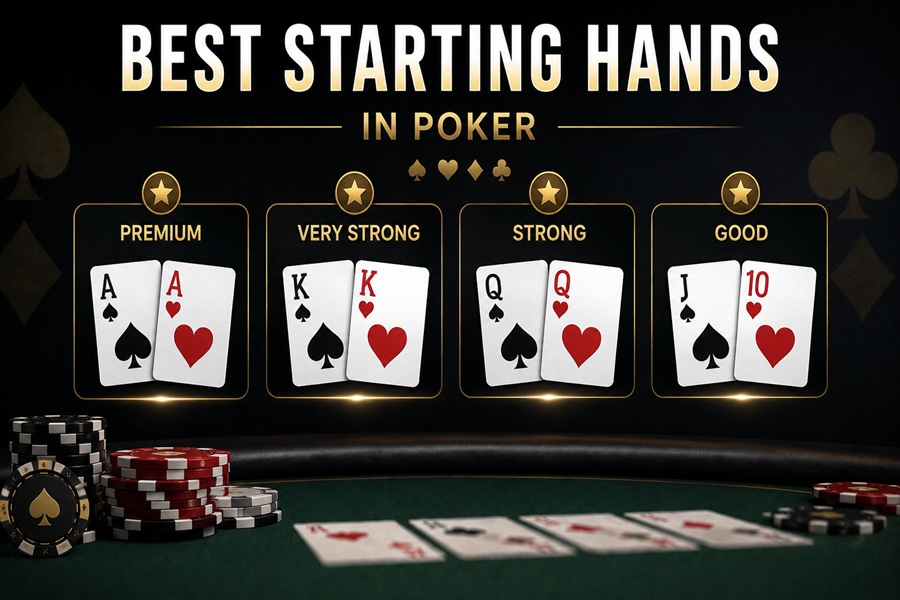
    The best starting hand in poker is pocket aces (A-A), followed by pocket kings, pocket queens, pocket jacks, and ace-king suited. These premium hands win the most before the flop and hold up under pressure. In Texas Hold’em there are 169 distinct starting hands, but only a small group is strong enough to play from anywhere at the table.

    Your two hole cards are the foundation of every decision that follows. Pick them well and the rest of the hand gets easier. Here is the ranking, the reasoning, and the one factor that changes everything.

    What is the best starting hand in poker?

    Pocket aces. Every time.

    Before the flop, A-A beats every other hand statistically. Heads-up against a single random hand, it wins around 80% of the time. That is dominant, though not unbeatable, and it is why you play it aggressively.

    The catch: aces win less often as more players see the flop. At a full table, someone can catch a lucky board. So the goal with aces is usually to thin the field by raising, not to trap a crowd.

    What are the top 10 starting hands in Texas Hold’em?

    Here is the broadly agreed ranking of the strongest hands, with rough heads-up win rates and a note on each. “Suited” means both cards share a suit. “Offsuit” means they do not.

    Rank Hand Win rate (heads-up) Note
    1 A-A ~85% The best. Raise and thin the field.
    2 K-K ~82% Second only to aces. Beware an ace on the flop.
    3 Q-Q ~80% Strong, but overcards appear often.
    4 J-J ~77% Powerful yet tricky. A coin flip against A-K.
    5 A-K suited ~67% The best drawing hand. Big upside, needs to connect.
    6 T-T ~75% The best pair with no ace or face card.
    7 A-K offsuit ~65% Same power as suited, slightly less flush upside.
    8 A-Q suited ~66% Strong, but respect A-K.
    9 9-9 ~72% A solid pair that flops sets and overpairs.
    10 A-J suited ~65% Playable and pretty, but easily dominated.

    Two ideas to take from this table:

    • Pairs rank high because they are already a made hand. They do not need the board to cooperate.
    • Suited beats offsuit, but only by a little. The flush it adds is worth roughly a couple of percent, not a transformation.

    Why are pocket pairs so strong?

    Because they start ahead. A pair does not need to improve to beat unpaired hands.

    A pocket pair also has a hidden weapon: the set. If you flop a third card of your rank, you have three of a kind that opponents rarely see coming. Holding J-J on a ten-high board against ace-ten is exactly the spot where big money changes hands.

    The trade-off is that middle and small pairs get nervous when overcards hit. Jacks and tens are the classic example. They crush random hands but lose to the three pairs above them, and they are only even money against ace-king. Play them with confidence, but be ready to fold when the board and the betting scream danger.

    Which hands are premium, and how rare are they?

    Poker players group starting hands into tiers. The tightest, safest group is the premium tier: hands you can play profitably from any seat.

    Tier Hands When to play
    Premium A-A, K-K, Q-Q, J-J, A-K, A-Q suited From any position
    Strong T-T, 9-9, A-Q offsuit, A-J suited, K-Q suited From middle and late position
    Speculative Small pairs, suited connectors, suited aces Mostly late position, cheaply

    Premium hands are rare, which is the whole reason patience pays. Consider the odds:

    • You are dealt pocket aces about once every 221 hands.
    • You are dealt tens or better about once every 43 hands.

    Those numbers explain why tight players can sit through long dry spells. Waiting is a real cost, but folding weak hands is what protects your stack for the moments that matter.

    How does position change which hands to play?

    This is the factor most beginners miss, and the one experienced coaches stress hardest. A starting hand does not have a fixed value. Where you sit changes it completely.

    Acting later is a huge advantage. You see what everyone does before you decide, so you play with more information.

    • Early position (first seats after the blinds): stick to premium hands. The top of the ranking is your floor here, not your ceiling.
    • Middle position: widen a little to include strong hands and a few speculative ones.
    • Late position (near the button): open up. You can profitably play suited connectors, smaller pairs, and suited aces because you control the hand.

    A hand like king-queen suited proves the point. It is genuinely strong, yet many amateurs underplay it. Played aggressively from good position, it makes strong hands and quiet profit. Played timidly from early position, it leaks money.

    Do the best starting hands change in other poker games?

    Yes. This ranking is for Texas Hold’em.

    Omaha uses four hole cards and requires you to use exactly two, so hand values shift dramatically. Double-suited hands with connected cards like A-A-K-K become the giants there. In lowball games like Razz or 2-7, the “best” hand is the lowest one, flipping the logic entirely.

    So treat this list as the Hold’em foundation. The instinct it builds, favoring pairs, high cards, and position, carries over. The exact rankings do not.

    What are the worst starting hands?

    The bottom of the pile is seven-two offsuit. The cards cannot make a straight together, do not share a suit, and are low. It is the classic auto-fold.

    Other weak holdings include unconnected, unsuited low cards like 8-3 offsuit and 9-4 offsuit. They rarely connect with the board in a way that wins. Muck them and wait.

    Frequently asked questions

    What is the number one starting hand in poker?

    Pocket aces (A-A). It is the strongest hand before the flop in Texas Hold’em.

    How many starting hands are there in Texas Hold’em?

    169 distinct hands, made up of 13 pocket pairs, 78 suited combos, and 78 offsuit combos, for 1,326 total two-card combinations.

    Is ace-king a good starting hand?

    Yes. Ace-king is the best drawing hand and a premium holding, especially suited. It needs to connect with the board to reach its full value.

    How often do you get pocket aces?

    About once every 221 hands.

    Does suited really matter?

    It helps, adding flush potential worth a few percent, but it does not turn a weak hand into a strong one on its own.

  • Global Poker Bonus Code: How the Welcome Offer Actually Works

    Global Poker Bonus Code: How the Welcome Offer Actually Works

    A Global Poker bonus code unlocks the site’s welcome package for new players. The standard offer gives you free Gold Coins when you register and a boosted first purchase, commonly 150,000 Gold Coins for around $10 plus 30 free Sweeps Coins. Gold Coins are for fun play only. Sweeps Coins are the currency you can redeem for cash prizes or gift cards. Enter the code during sign-up, and note that exact amounts and availability change by state and over time.

    That is the short version. The important part is understanding how the two-coin system works, because it is the whole reason the bonus exists.

    What is a Global Poker bonus code?

    It is a short code you enter when you create an account or make your first coin purchase. The code links your account to a specific promotion.

    Global Poker runs on a sweepstakes model, not real-money gambling. That structure is why it operates legally in most US states. The bonus code is how the platform welcomes new players into that model with free currency.

    Codes are often tied to specific partners and promotions, so you may see different codes floating around. Always confirm the current code and its terms before you sign up.

    Use bonus code [BONUS CODE] during registration to claim the current welcome offer.

    How does the two-coin system work?

    This is the single most important thing to understand before you claim anything. Global Poker uses two separate currencies.

    Currency What it is Can you redeem it?
    Gold Coins (GC) Play money for casual games No, purely for fun
    Sweeps Coins (SC) Promotional currency Yes, for cash prizes or gift cards

    You buy Gold Coins if you want. You never buy Sweeps Coins directly. Instead, SC arrive as a bonus attached to a Gold Coin purchase, or through free methods like giveaways and mail-in requests. Winning with Sweeps Coins is what can be redeemed.

    This split is what keeps the model legal. You are always able to play for free, and no purchase is ever required to receive Sweeps Coins.

    What does the Global Poker welcome offer include?

    The welcome package generally has two parts: a free sign-up bonus and a boosted first purchase.

    Part What you typically get
    On registration (free) A batch of free Gold Coins, no purchase needed
    First purchase (optional) Around 150,000 Gold Coins for roughly $10, plus 30 free Sweeps Coins

    A few honest points that reviewers and long-time players raise:

    • The free sign-up amount and the exact first-purchase discount vary by state and change over time. Treat any specific figure as a snapshot, not a guarantee.
    • The first-purchase deal is usually framed as a discount, sometimes described as a 200% boost, on a package that normally costs more.
    • You will likely need to verify your identity before making a purchase or redeeming, using a document like a driver’s license or passport.

    Always check the current numbers on the official site before you decide.

    How do you claim the Global Poker bonus?

    The process is quick, usually a few minutes start to finish.

    1. Visit the official Global Poker site and choose to register.
    2. Enter your details and the bonus code [BONUS CODE] where prompted.
    3. Confirm you meet the age requirement of 21 or older and that you are in an eligible location.
    4. Verify your email through the link Global Poker sends you.
    5. Collect your free sign-up Gold Coins, which land in your account automatically.
    6. Optionally, complete identity verification and make the first purchase to claim the boosted package and free Sweeps Coins.

    That is it. You can play immediately with your free coins, with no obligation to buy.

    Can you get Sweeps Coins without paying?

    Yes. This is central to how the model stays legal, and it is worth knowing.

    Free ways to collect Sweeps Coins have historically included:

    • Daily login bonuses, which can build over consecutive days of activity.
    • Social media giveaways and community promotions.
    • Mail-in requests, the traditional no-purchase-necessary route.

    The catch worth flagging: these free methods and their terms change. Some request routes have been scaled back over time. Check the current promotions page for what is active now.

    What is the playthrough and redemption process?

    Before you can redeem Sweeps Coins, you have to play them.

    • Playthrough: Sweeps Coins usually carry a light requirement, often playing through each SC one time before it becomes redeemable.
    • Minimum redemption: There is typically a low minimum, commonly around 10 SC, to cash out for a gift card or prize.
    • Withdrawals: Global Poker is generally known for not charging withdrawal fees.

    Compared with many social casinos, this is a relatively player-friendly redemption setup. Still, always read the current terms, because thresholds shift.

    Is Global Poker available in your state?

    Not everywhere, and this is changing fast. This is the part most bonus articles bury, and it matters more than any coin figure.

    Global Poker operates in most US states but is restricted in several. It has also exited California following state legislation targeting sweepstakes platforms, and it remains unavailable in a number of other states. The list of excluded states has been growing as more legislatures act.

    Because the legal picture is moving, do not assume the offer is open to you. Confirm availability for your specific state on the official site before you sign up. You must also be 21 or older.

    Is Global Poker legit and safe?

    By reputation, yes. It is one of the larger and longer-running social poker platforms, part of a family of well-known sweepstakes sites, with a busy player pool at most hours.

    A balanced view from player reviews:

    • Upsides: steady game traffic, no withdrawal fees, a genuine free-to-play path, and a real poker focus rather than only slots.
    • Downsides: the welcome offer is modest compared with some rivals, payment options are limited, and Sweeps Coins cannot be converted back into Gold Coins.

    As with any platform involving money, play within a budget and treat it as entertainment. If gambling ever stops feeling fun, step away and seek support resources in your area.

    Frequently asked questions

    Do you need a bonus code for Global Poker?

    The welcome offer is usually tied to a code entered at sign-up. Free sign-up coins may arrive without one, but the boosted package generally needs the code.

    Is the Global Poker bonus really free?

    The sign-up Gold Coins are free. The Sweeps Coins come free with a first purchase or through no-purchase methods like giveaways and mail-in requests.

    How much is the Global Poker welcome offer?

    It commonly centers on 150,000 Gold Coins for about $10 plus 30 free Sweeps Coins, but amounts vary by state and change over time.

    Can I win real money on Global Poker?

    You can win Sweeps Coins, which are redeemable for cash prizes or gift cards after meeting the playthrough requirement.

    How old do you have to be?

    You must be at least 21 to play.

  • The Types of Poker Games, Sorted by How They Play

    The Types of Poker Games, Sorted by How They Play

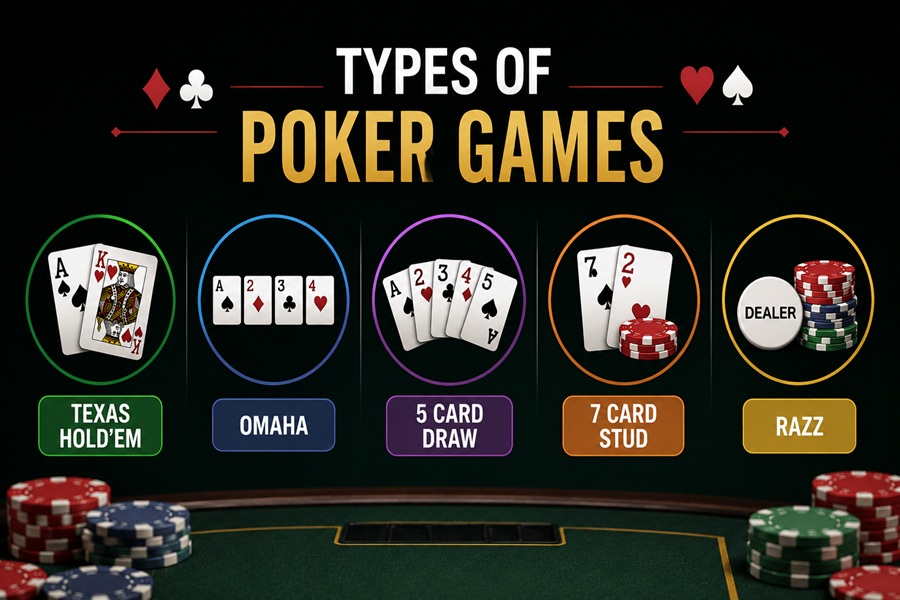
    Quick answer: The main types of poker games fall into four families based on how cards are dealt: community card games (Texas Hold’em, Omaha), stud games (Seven-Card Stud, Razz), draw games (Five-Card Draw, Badugi), and mixed games that rotate several formats (HORSE). Texas Hold’em is the most popular and the friendliest place to start. Everything else builds a different skill.

    Most players learn one game and stop. That is a mistake. Coaches who have trained thousands of players say the same thing in forums and blogs: learning even one variant beyond Hold’em sharpens how you read every game. Here is the full map.

    What are the main categories of poker games?

    Nearly every poker game fits into one of these buckets. The difference is where your cards come from and who can see them.

    Category How it works Famous examples
    Community card Hidden hole cards combine with shared face-up cards Texas Hold’em, Omaha
    Stud You get a mix of face-up and face-down cards over several streets Seven-Card Stud, Razz
    Draw All cards hidden, you swap some for new ones Five-Card Draw, Badugi
    Mixed Several formats rotate in turns HORSE, Eight-Game Mix

    A second split matters too. Some games award the pot to the highest hand, some to the lowest (lowball), and some split it between the two. Keep both layers in mind as you read on.

    Community card poker games

    These are the games you see on television. Players share face-up community cards in the middle of the table.

    Texas Hold’em. Two hole cards, five community cards, best five-card hand wins. Simple to learn, deep to master. No-Limit Hold’em is the most played format in the world. If you are new, start here.

    Omaha. You get four hole cards, but you must use exactly two of them plus three community cards. That rule creates bigger hands and wilder swings. The popular version is Pot-Limit Omaha, or PLO. It is the second most common game in most rooms. More action, more variance, less beginner-friendly.

    Short Deck (Six Plus Hold’em). Hold’em with the 2s through 5s removed. Fewer cards mean more big hands and a different ranking order. A favorite in high-stakes cash games.

    Pineapple and Crazy Pineapple. Hold’em variants where you start with three hole cards and discard one. A fun home-game twist that adds an early decision.

    Royal Hold’em. Played with only tens through aces. Big hands come fast. A niche, high-energy variant.

    Stud poker games

    Stud is older than community card poker and plays very differently. There is no flop. You build a hand across several betting rounds called streets, seeing some of your opponents’ cards face up.

    Seven-Card Stud. The classic. Each player receives seven cards over five streets, some up and some down, and makes the best five-card hand. It rewards memory. Tracking folded cards is a real edge.

    Five-Card Stud. The simplest stud game. Fewer cards, less to track, more about nerve.

    Razz. Seven-Card Stud played for the lowest hand. Straights and flushes do not count against you. The best possible hand is 5-4-3-2-A. Patience is everything.

    Stud Hi-Lo (Eight or Better). A split-pot version. Half the pot goes to the best high hand, half to the best qualifying low. You are chasing two goals at once.

    Draw poker games

    In draw poker, all your cards stay hidden. You improve your hand by discarding and drawing replacements. There are no shared cards and no face-up information, so reads and betting patterns carry the weight.

    Five-Card Draw. The kitchen-table classic. One draw, best hand wins. Easy to learn, and a clean introduction to bluffing.

    2-7 Triple Draw. A lowball game with three draws. The goal is the worst hand by high-card rules, where 7-5-4-3-2 is the nuts. A staple in mixed-game lineups.

    Badugi. A four-card lowball game with a unique twist: you want four cards of different suits and different ranks. The perfect hand is A-2-3-4 of four suits. It looks strange at first and hooks people fast.

    Split-pot and lowball games

    Some games hand the pot to the lowest hand, and some cut it in half.

    Lowball examples include Razz and 2-7 Triple Draw, covered above. Split-pot examples include Omaha Hi-Lo (PLO8), Stud Hi-Lo, and Big O, a five-card Omaha Hi-Lo variant that has grown popular in cash games. In these, chasing both the high and the low can double your share, but scooping the whole pot is the real prize.

    What are mixed games in poker?

    Mixed games rotate through several variants, switching format after a set number of hands or each time the blinds go up. They test whether you are a complete player or a one-trick specialist.

    HORSE. The most famous mix. It rotates Hold’em, Omaha Hi-Lo, Razz, Seven-Card Stud, and Stud Eight-or-Better. The name is an acronym for those five.

    Eight-Game Mix. A broader rotation used in high-stakes play. It adds 2-7 Triple Draw and both limit Hold’em and Pot-Limit Omaha to the HORSE lineup.

    Dealer’s Choice. A home-game format where the dealer picks the game each hand. Expect anything, including oddball variants like Badeucy or Drawmaha.

    Which type of poker game should you learn first?

    Start with Texas Hold’em. It has the most resources, the most tables, and the gentlest learning curve.

    Then branch out based on what you want to build:

    • Want more action and bigger pots? Try Pot-Limit Omaha.
    • Want to sharpen memory and patience? Learn Seven-Card Stud or Razz.
    • Want to master reads and deception? Play Five-Card Draw or 2-7 Triple Draw.
    • Want to become a complete player? Work into HORSE.

    One honest note echoed across poker communities: the skills transfer. Learn to read a stud board and you will read Hold’em ranges better. Learn Omaha equities and you will respect draws more. The players who never look past their first game leave that growth on the table.

    Frequently asked questions

    What is the most popular type of poker?

    No-Limit Texas Hold’em, by a wide margin, both live and online.

    What are the three main types of poker?

    Community card games, stud games, and draw games. Mixed games combine them.

    What is the hardest poker variant to master?

    Mixed games like HORSE and the Eight-Game Mix, because they demand skill across many formats at once.

    What is a good second poker game to learn?

    Pot-Limit Omaha is the natural next step for most Hold’em players.

    Which poker game is best for beginners?

    Texas Hold’em, followed by Five-Card Draw for casual home play.