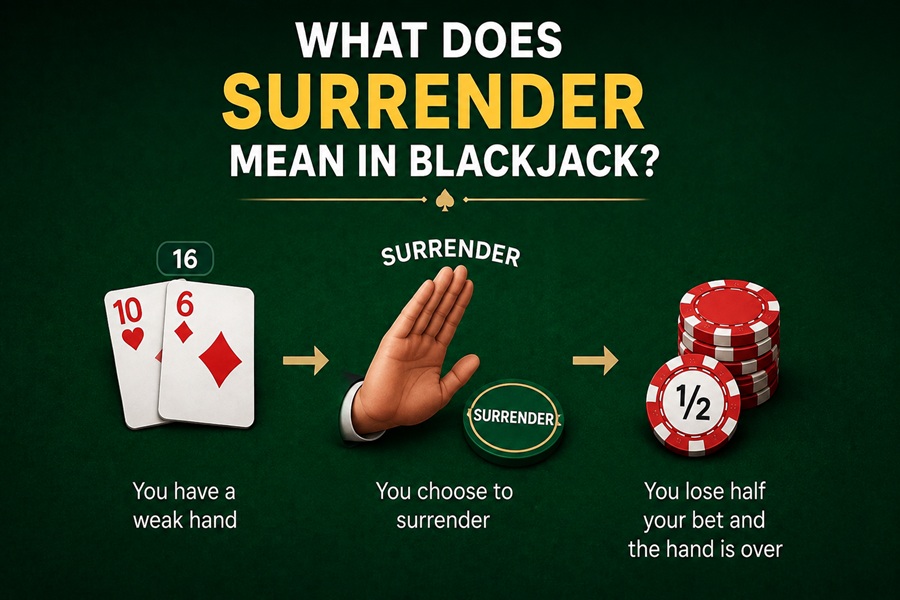
Surrender in blackjack means giving up your hand and forfeiting half your bet instead of risking the whole thing. You use it on weak hands that are likely to lose. Rather than fighting a losing spot, you fold, keep half your wager, and move on. Used correctly, it lowers the house edge and stretches your bankroll.
Think of it as a smart exit, not a white flag. Here is how it works and when to pull the trigger.
What does surrender mean in blackjack?
Surrender is an optional rule that lets you quit a hand early. You give up half your bet and keep the other half. The hand is over.
You only get the choice after seeing your first two cards and the dealer’s upcard. If the situation looks grim, and losing more than half your bet on average is likely, surrendering cuts the damage.
The guiding principle is straightforward. If your hand has less than a 50 percent chance of winning, surrender becomes worth considering. Losing half a bet beats losing a whole one most of the time in those spots.
What is the difference between early and late surrender?
This is the part that matters most, and the part casual players get wrong. There are two versions, and they are worlds apart in value.
| Feature | Early surrender | Late surrender |
|---|---|---|
| When you decide | Before the dealer checks for blackjack | After the dealer checks for blackjack |
| Dealer has a natural | You still keep half your bet | You lose your full bet |
| Value to the player | Large, cuts the house edge sharply | Small but still useful |
| How common | Very rare, nearly extinct | The standard version today |
| House edge reduction | About 0.62 percent | Only a small fraction |
Early surrender lets you fold before the dealer peeks for blackjack. Even if the dealer turns out to have a natural, you still walk away with half your bet. That protection is powerful, which is exactly why casinos removed it from almost every table.
Late surrender is the version you will actually find. You can only surrender after the dealer checks and does not have blackjack. If the dealer does have a natural, the hand is already lost, and you cannot surrender out of it.
Blackjack strategy sites and long-time players are blunt about this. If you are unsure which version a table offers, assume late surrender. Early surrender is so rare that when it appears at a live table, it is often a dealer mistake rather than a house rule.
When should you surrender in blackjack?
Surrender only helps in a handful of ugly spots. Reach for it on hard totals that are heavy underdogs against a strong dealer upcard.
For the common late-surrender game, the classic spots are:
- Hard 16 against a dealer 9, 10, or ace. A pair of 8s is the exception, since splitting is usually better.
- Hard 15 against a dealer 10. Against a dealer ace, surrender too if the dealer hits soft 17.
- Hard 17 against a dealer ace, but only when the dealer hits soft 17.
Everything else, you play out. Surrender is a scalpel, not a hammer. Use it in those narrow cases and nowhere else.
To picture why it pays, take a hand of 9-7 for 16 against a dealer 10. Play it out and you lose more than half your bet on average across many hands. Surrender and you lose exactly half, guaranteed. Over hundreds of hands, that difference adds up.
What is composition-dependent surrender?
Here is a nuance the top guides usually skip, and one that separates a casual player from a sharp one.
Not all 16s are the same. A 16 made of 9-7 behaves differently from a 16 made of 8-8, and both differ from a 10-6. The exact cards in your hand slightly change the odds, because they remove specific cards from the remaining deck.
In single-deck games with certain rules, this can flip a decision. You might surrender a 9-7 but play out an 8-7 for 15, even though the totals are close. There are more than a dozen such exceptions.
The honest takeaway, echoed by experienced players in strategy communities: the edge from composition-dependent surrender is tiny and the rules are fiddly. Newer players are better off learning the standard total-based spots first and leaving the fine print to veterans.
How do you signal a surrender at the table?
At a live table, you say it out loud and back it with a hand signal.
- Say “surrender” clearly to the dealer.
- Draw a horizontal line behind your bet with your finger, as if cutting it off.
Online, there is usually a dedicated surrender button that appears only when the move is available. If you do not see the option, the table does not offer it.
What are the pros and cons of surrender?
Surrender is a genuine advantage, but it comes with trade-offs. Players in forums debate its feel as much as its math.
The upside:
- It lowers the house edge when used correctly.
- It saves half your bet in spots where you were likely to lose the whole thing.
- It stretches your bankroll. For every two hands you surrender, you save roughly enough for one more bet, so you play longer.
The downside:
- It reduces the excitement. No one enjoys folding a hand, even when the math approves.
- It is easy to misuse. Surrendering good or borderline hands throws away value fast.
- It is hard to find. Early surrender is nearly gone, and many tables offer no surrender at all.
Which games offer surrender?
Surrender shows up most often in games dealt from six or eight decks. Single-deck and double-deck tables rarely offer it.
You will also find it on many online blackjack tables and electronic table games, more reliably than at brick-and-mortar tables in some regions. When a table does offer it, that is a small point in the player’s favor, so it is worth seeking out alongside a 3-to-2 payout.
Frequently asked questions
What does surrender mean in blackjack?
It means folding your hand and giving up half your bet to avoid risking the full amount on a likely losing hand.
When should I surrender in blackjack?
On heavy underdog hands, mainly hard 16 against a dealer 9, 10, or ace, and hard 15 against a dealer 10.
Is early or late surrender better?
Early surrender is far better for the player, but it is nearly extinct. Late surrender is the common version and still helps.
Does surrender lower the house edge?
Yes. Early surrender cuts it by about 0.62 percent. Late surrender helps by a smaller amount.
Can I surrender after hitting?
No. Surrender is only available on your first two cards, before you take any other action.