
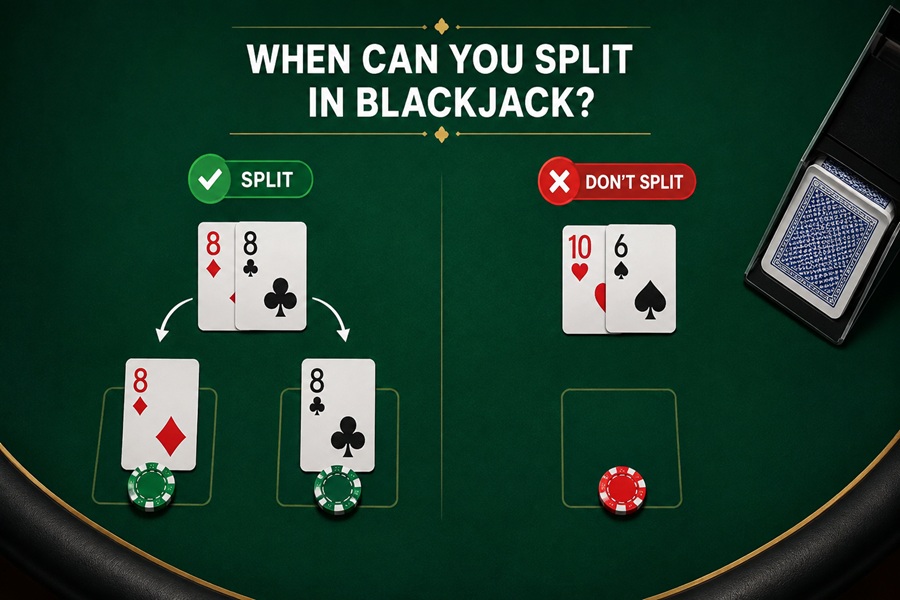
Quick answer: You can split in blackjack whenever your first two cards form a pair, meaning two cards of the same value. Splitting turns one hand into two separate hands. You place a second bet equal to your first, then play each hand on its own. The most trusted rule in the game is simple: always split aces and 8s, never split 5s or 10s.
That covers the “when you can.” The rest of this guide covers the “when you should,” pair by pair.
What does splitting actually mean in blackjack?
Splitting lets you break a pair into two hands.
Say you are dealt two 8s. Instead of playing a single hand worth 16, you separate them. Now you have two hands, each starting with an 8. You match your original bet on the new hand, so you have two bets and two chances to beat the dealer.
The dealer then gives each hand a new second card. You play the first hand to completion, then the second.
When can you split? The core rules
You can split only when your first two cards qualify and the table allows it. Here is what governs the move:
- A matching pair. You need two cards of equal value. Two 7s, two queens, two aces.
- Only on the opening hand. Once you hit, stand, or double, the option is gone.
- A second, equal bet. Splitting always costs another wager the size of your first.
- 10-value rules vary. Most casinos let you split any two 10-value cards, like a jack and a king. Some allow it only when the ranks match exactly.
- Split aces get one card each. After splitting aces, you receive a single card per ace and cannot hit again. If that card is a 10, you have 21, but it counts as a normal 21, not a natural.
To signal a split at a live table, place your extra chips beside your original bet. Do not stack them on top. Some players also make a small V shape with two fingers on the felt.
Which pairs should you always split?
Two pairs are automatic. Every serious strategy chart agrees, and so does the wider blackjack community, from Wikipedia’s strategy pages to long-running forum threads.
Aces. Two aces total 2 or 12. Both are weak. Split them and each ace becomes the start of a strong new hand, with a real chance of drawing a 10 for 21.
Eights. Two 8s total 16, the worst hand in blackjack. Hit a 16 and you bust well over half the time. Splitting gives you two fresh hands that start from 8, which is a far better place to build from.
There is one advanced exception. Against a dealer ace, when the dealer hits soft 17 and surrender is offered, surrendering a pair of 8s can edge out splitting. In single-deck games with certain rules, the math can also shift. For nearly every table you will sit at, split them.
Which pairs should you never split?
Two pairs should stay together, always.
Tens. Two 10-value cards make 20. That is a near-winning hand. Splitting throws away a great total for two weaker ones. A common heuristic from experienced players: ask what a random 10 does to each half. Splitting a 20 into two 10s invites two mediocre hands instead of one excellent one.
Fives. A pair of 5s totals 10. That is a strong doubling hand, not a splitting hand. Split it and you start two hands from 5, both awkward. Double down or hit instead.
What about the tricky pairs?
Most pairs live in the middle. The right move depends on the dealer’s upcard. Use the table below as a starting reference. It follows standard basic strategy for a multi-deck game where the dealer stands on soft 17.
| Your pair | Split when dealer shows | Otherwise |
|---|---|---|
| Aces (A-A) | Always | Always split |
| 10s / faces | Never | Stand on 20 |
| 9s | 2 through 9, except 7 | Stand on 7, 10, or ace |
| 8s | Always | Always split |
| 7s | 2 through 7 | Hit |
| 6s | 2 through 6 | Hit |
| 5s | Never | Double or hit |
| 4s | 5 and 6 (if double after split is allowed) | Hit |
| 3s | 2 through 7 | Hit |
| 2s | 2 through 7 | Hit |
A few notes that most charts leave unexplained:
- Nines skip the 7. You stand on 18 against a dealer 7 because the dealer likely holds a 10 for 17, and your 18 already wins. Split against 2 through 6, 8, and 9.
- Fours only split with backup. A pair of 4s makes 8, a fine hitting total. Splitting is worth it only when you can double after the split, and only against a dealer 5 or 6.
How do table rules change when to split?
The chart above assumes common rules. Change the rules and some borderline plays flip. This is the part most beginner guides ignore.
Double after split (DAS). When a table lets you double down after splitting, low pairs like 2s, 3s, 4s, and 6s become more profitable to split. You gain a follow-up option that makes the split pay off.
No double after split (NDAS). Without that option, those same low pairs lose value. Splitting 4s or 6s becomes weaker, because you cannot press a strong follow-up card.
Re-splitting. Draw another matching card after a split and many casinos let you split again. Common limits are up to three or four total hands. Re-splitting 8s is a strong play when allowed.
Aces are special. Most tables limit you to one card per split ace and forbid re-splitting them. A few generous tables allow re-splitting aces, which is a rare bonus for the player.
Always check the felt and, at a live table, ask the dealer. Two tables that look identical can carry very different splitting rules.
How often do you even get to split?
Less often than you might think, which is why knowing the play matters when the chance comes.
The odds of being dealt any single pair from aces through nines sit at roughly half a percent each. The odds of two 10-value cards are higher, near 9 to 10 percent, because there are 16 such cards in the deck. So most of your split decisions will involve tens, and the answer there is almost always to stand.
Frequently asked questions
Can you split any two cards in blackjack?
No. You can split only a pair, meaning two cards of the same value.
Can you split two kings or a king and a queen?
Two kings, yes. A king and a queen depends on the casino. Some allow any 10-value split, others require matching ranks. Either way, you should stand on the 20.
How many times can you split in blackjack?
Usually up to three or four hands total, depending on the casino. Split aces are often limited to one split.
Do you have to bet more to split?
Yes. Each split requires a new bet equal to your original one.
Is splitting worth it?
When done correctly, yes. Splitting the right pairs turns weak hands into strong ones and lowers the house edge over time.