
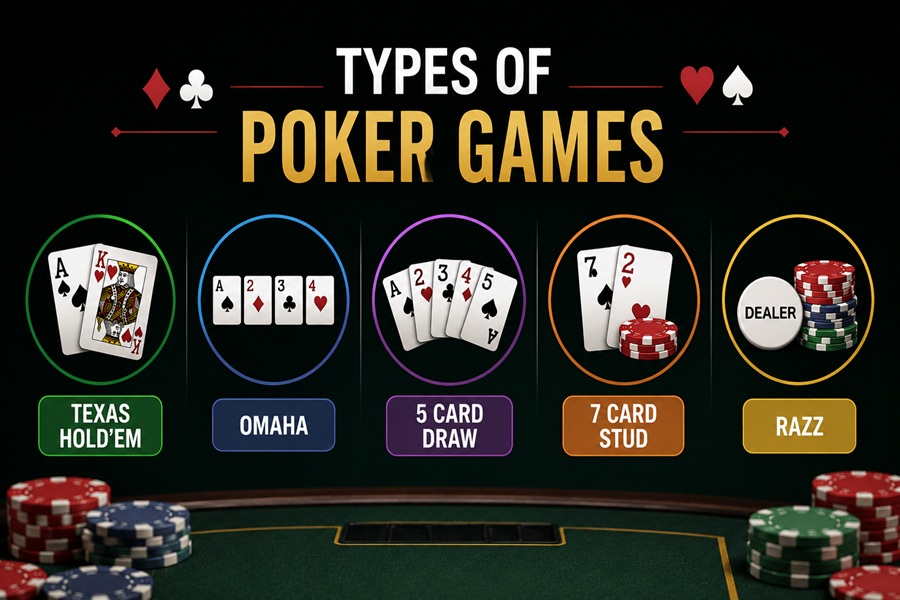
Quick answer: The main types of poker games fall into four families based on how cards are dealt: community card games (Texas Hold’em, Omaha), stud games (Seven-Card Stud, Razz), draw games (Five-Card Draw, Badugi), and mixed games that rotate several formats (HORSE). Texas Hold’em is the most popular and the friendliest place to start. Everything else builds a different skill.
Most players learn one game and stop. That is a mistake. Coaches who have trained thousands of players say the same thing in forums and blogs: learning even one variant beyond Hold’em sharpens how you read every game. Here is the full map.
What are the main categories of poker games?
Nearly every poker game fits into one of these buckets. The difference is where your cards come from and who can see them.
| Category | How it works | Famous examples |
|---|---|---|
| Community card | Hidden hole cards combine with shared face-up cards | Texas Hold’em, Omaha |
| Stud | You get a mix of face-up and face-down cards over several streets | Seven-Card Stud, Razz |
| Draw | All cards hidden, you swap some for new ones | Five-Card Draw, Badugi |
| Mixed | Several formats rotate in turns | HORSE, Eight-Game Mix |
A second split matters too. Some games award the pot to the highest hand, some to the lowest (lowball), and some split it between the two. Keep both layers in mind as you read on.
Community card poker games
These are the games you see on television. Players share face-up community cards in the middle of the table.
Texas Hold’em. Two hole cards, five community cards, best five-card hand wins. Simple to learn, deep to master. No-Limit Hold’em is the most played format in the world. If you are new, start here.
Omaha. You get four hole cards, but you must use exactly two of them plus three community cards. That rule creates bigger hands and wilder swings. The popular version is Pot-Limit Omaha, or PLO. It is the second most common game in most rooms. More action, more variance, less beginner-friendly.
Short Deck (Six Plus Hold’em). Hold’em with the 2s through 5s removed. Fewer cards mean more big hands and a different ranking order. A favorite in high-stakes cash games.
Pineapple and Crazy Pineapple. Hold’em variants where you start with three hole cards and discard one. A fun home-game twist that adds an early decision.
Royal Hold’em. Played with only tens through aces. Big hands come fast. A niche, high-energy variant.
Stud poker games
Stud is older than community card poker and plays very differently. There is no flop. You build a hand across several betting rounds called streets, seeing some of your opponents’ cards face up.
Seven-Card Stud. The classic. Each player receives seven cards over five streets, some up and some down, and makes the best five-card hand. It rewards memory. Tracking folded cards is a real edge.
Five-Card Stud. The simplest stud game. Fewer cards, less to track, more about nerve.
Razz. Seven-Card Stud played for the lowest hand. Straights and flushes do not count against you. The best possible hand is 5-4-3-2-A. Patience is everything.
Stud Hi-Lo (Eight or Better). A split-pot version. Half the pot goes to the best high hand, half to the best qualifying low. You are chasing two goals at once.
Draw poker games
In draw poker, all your cards stay hidden. You improve your hand by discarding and drawing replacements. There are no shared cards and no face-up information, so reads and betting patterns carry the weight.
Five-Card Draw. The kitchen-table classic. One draw, best hand wins. Easy to learn, and a clean introduction to bluffing.
2-7 Triple Draw. A lowball game with three draws. The goal is the worst hand by high-card rules, where 7-5-4-3-2 is the nuts. A staple in mixed-game lineups.
Badugi. A four-card lowball game with a unique twist: you want four cards of different suits and different ranks. The perfect hand is A-2-3-4 of four suits. It looks strange at first and hooks people fast.
Split-pot and lowball games
Some games hand the pot to the lowest hand, and some cut it in half.
Lowball examples include Razz and 2-7 Triple Draw, covered above. Split-pot examples include Omaha Hi-Lo (PLO8), Stud Hi-Lo, and Big O, a five-card Omaha Hi-Lo variant that has grown popular in cash games. In these, chasing both the high and the low can double your share, but scooping the whole pot is the real prize.
What are mixed games in poker?
Mixed games rotate through several variants, switching format after a set number of hands or each time the blinds go up. They test whether you are a complete player or a one-trick specialist.
HORSE. The most famous mix. It rotates Hold’em, Omaha Hi-Lo, Razz, Seven-Card Stud, and Stud Eight-or-Better. The name is an acronym for those five.
Eight-Game Mix. A broader rotation used in high-stakes play. It adds 2-7 Triple Draw and both limit Hold’em and Pot-Limit Omaha to the HORSE lineup.
Dealer’s Choice. A home-game format where the dealer picks the game each hand. Expect anything, including oddball variants like Badeucy or Drawmaha.
Which type of poker game should you learn first?
Start with Texas Hold’em. It has the most resources, the most tables, and the gentlest learning curve.
Then branch out based on what you want to build:
- Want more action and bigger pots? Try Pot-Limit Omaha.
- Want to sharpen memory and patience? Learn Seven-Card Stud or Razz.
- Want to master reads and deception? Play Five-Card Draw or 2-7 Triple Draw.
- Want to become a complete player? Work into HORSE.
One honest note echoed across poker communities: the skills transfer. Learn to read a stud board and you will read Hold’em ranges better. Learn Omaha equities and you will respect draws more. The players who never look past their first game leave that growth on the table.
Frequently asked questions
What is the most popular type of poker?
No-Limit Texas Hold’em, by a wide margin, both live and online.
What are the three main types of poker?
Community card games, stud games, and draw games. Mixed games combine them.
What is the hardest poker variant to master?
Mixed games like HORSE and the Eight-Game Mix, because they demand skill across many formats at once.
What is a good second poker game to learn?
Pot-Limit Omaha is the natural next step for most Hold’em players.
Which poker game is best for beginners?
Texas Hold’em, followed by Five-Card Draw for casual home play.