
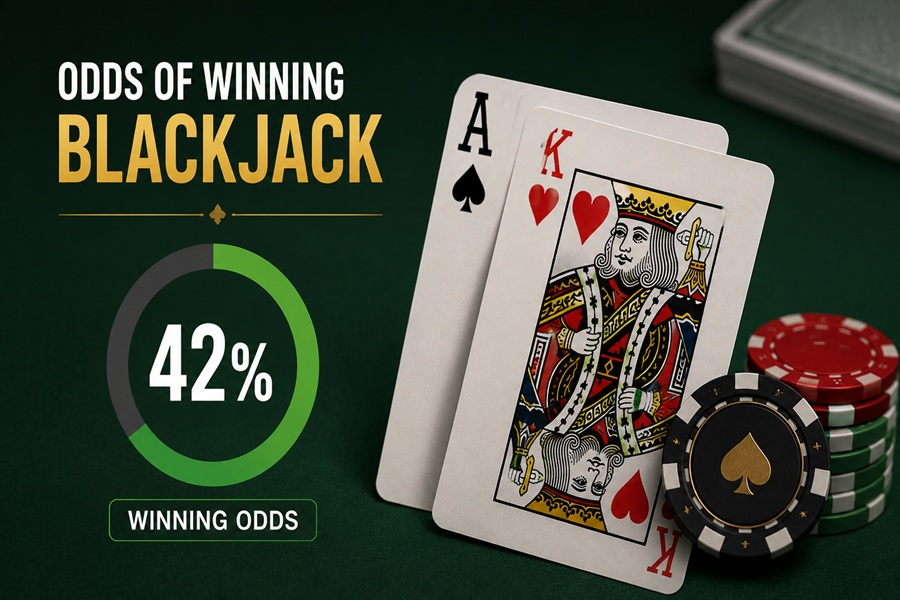
In a standard blackjack game, players win roughly 42 to 43 percent of hands, the dealer wins about 49 percent, and the remaining 8 to 9 percent end in a push (a tie). With perfect basic strategy, the house edge drops to around 0.5 percent, and under the best rules it can fall near 0.2 percent. That makes blackjack one of the best bets on the casino floor.
Those headline numbers hide a lot of useful detail. Here are the real odds, broken down by outcome, by hand, and by rule.
What are the odds of winning a hand of blackjack?
The player is a slight underdog on any single hand. The three outcomes break down like this.
| Outcome | Approximate chance |
|---|---|
| Player wins | 42 to 43 percent |
| Dealer wins | 49 percent |
| Push (tie) | 8 to 9 percent |
Why is the player behind? One structural reason. The player always acts first. Bust your hand and you lose immediately, even if the dealer would have busted moments later. That “player busts first” rule is the single biggest source of the house’s built-in edge.
The good news: the gap is small, and skill closes most of it.
What is the house edge in blackjack?
The house edge is the casino’s long-term advantage, expressed as a percentage of every bet.
- With basic strategy: around 0.5 percent. For every 100 units you wager, you lose about 50 units of expected value over time.
- Under the best rules: as low as roughly 0.2 percent.
- Without strategy: 2 percent or higher, depending on how loosely you play.
Put that against other casino games and blackjack shines. European roulette carries a house edge near 2.7 percent, more than five times the blackjack figure for a strategy player. This is why long-running blackjack forums and communities keep repeating the same advice: learn basic strategy first, everything else second.
What are the odds of being dealt a blackjack?
A natural blackjack, an ace with any 10-value card on your first two cards, comes up about 4.8 percent of the time. That is close to 1 in every 21 hands.
It pays a bonus, usually 3 to 2. Bet 10 and collect 15.
Here is the catch that costs casual players the most. Many tables now pay 6 to 5 instead. That single change raises the house edge by about 1.39 percent, which is enormous relative to the 0.5 percent you started with. On a 6-to-5 table, a natural pays 12 instead of 15 on a 10-unit bet. Always find the 3-to-2 game.
What are your odds of busting when you hit?
Your bust risk depends entirely on your current total. This table shows the chance of going over 21 if you take one more card on a hard hand.
| Your hard total | Chance of busting if you hit |
|---|---|
| 11 or lower | 0 percent |
| 12 | 31 percent |
| 13 | 39 percent |
| 14 | 56 percent |
| 15 | 58 percent |
| 16 | 62 percent |
| 17 | 69 percent |
| 18 | 77 percent |
| 19 | 85 percent |
| 20 | 92 percent |
This is why strategy tells you to stand on stiff totals in the right spots. Hitting a 16 busts you nearly two times in three. Hitting anything 11 or below can never bust you, which is why those totals are automatic hits or doubles.
What are the odds of the dealer busting?
The dealer’s bust chance hinges on their upcard. Weak upcards bust often. Strong upcards rarely do. These are approximate figures for a game where the dealer stands on soft 17.
| Dealer upcard | Approximate bust chance |
|---|---|
| 2 | 35 percent |
| 3 | 37 percent |
| 4 | 40 percent |
| 5 | 42 percent |
| 6 | 42 percent |
| 7 | 26 percent |
| 8 | 24 percent |
| 9 | 23 percent |
| 10 | 21 percent |
| Ace | 17 percent |
Read the pattern. A dealer showing 4, 5, or 6 busts around 40 percent of the time. That is why you stand on a stiff hand and let the dealer take the risk. A dealer showing 9, 10, or ace busts only about one time in five, so you have to build your own total higher to compete.
Which rules move the odds the most?
Not all blackjack tables are equal. The rules on the felt can swing the house edge by a full percentage point or more. Here is how the big ones cut.
| Rule | Effect on the player |
|---|---|
| Blackjack pays 3 to 2 | Baseline, good for you |
| Blackjack pays 6 to 5 | Adds about 1.39 percent to the house edge |
| Dealer stands on soft 17 | Helps you by about 0.2 percent |
| Dealer hits soft 17 | Hurts you by about 0.2 percent |
| Double after split allowed | Helps you |
| Surrender offered | Helps you |
| Fewer decks | Generally helps you |
Two tables can look identical and carry very different odds. Before you sit, check the payout, the soft-17 rule, and the deck count. Those three details tell you most of what you need to know.
Does card counting really change the odds?
Yes, but modestly and with effort.
Card counting tracks the ratio of high to low cards left in the shoe. When many 10-value cards and aces remain, the player has a small edge, because naturals and strong hands become more likely. Counters raise their bets in those moments.
A few honest points, the kind you will read from experienced players in forums rather than from casino marketing:
- Counting is legal. It is not cheating. But casinos are private businesses and may ask a suspected counter to leave.
- The edge a skilled counter gains is small, often a fraction of one percent. It rewards discipline and volume, not luck.
- It does nothing for you on a single hand. It is a long-run betting strategy, not a magic trick.
Can you actually win at blackjack?
Over a single session, absolutely. Over a lifetime, the math is a headwind.
The house edge is a long-run average. In the short term, variance rules. A player can hit a hot streak and walk away well ahead, which is exactly why casinos set table limits: to stay solvent through those streaks while the edge grinds in their favor over millions of hands.
So the realistic framing is this. Blackjack gives you the best odds of any common table game. Basic strategy shrinks the house edge to near nothing. From there, whether you win tonight comes down to variance. Whether you win over years comes down to the small edge that never fully disappears.
Frequently asked questions
What percentage of blackjack hands does the player win?
About 42 to 43 percent, with roughly 8 to 9 percent ending in a push.
What are the odds of getting a blackjack?
Around 4.8 percent, or about 1 in 21 hands.
Is blackjack the best odds in the casino?
For a strategy player, yes. Its house edge of about 0.5 percent beats roulette, slots, and most other table games.
Do more decks make the odds worse?
Generally, yes. Fewer decks tend to favor the player, though the difference is small.
Does basic strategy guarantee a win?
No. It minimizes the house edge to about 0.5 percent, but it cannot remove the casino’s advantage entirely.